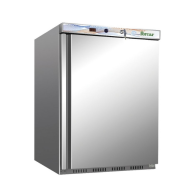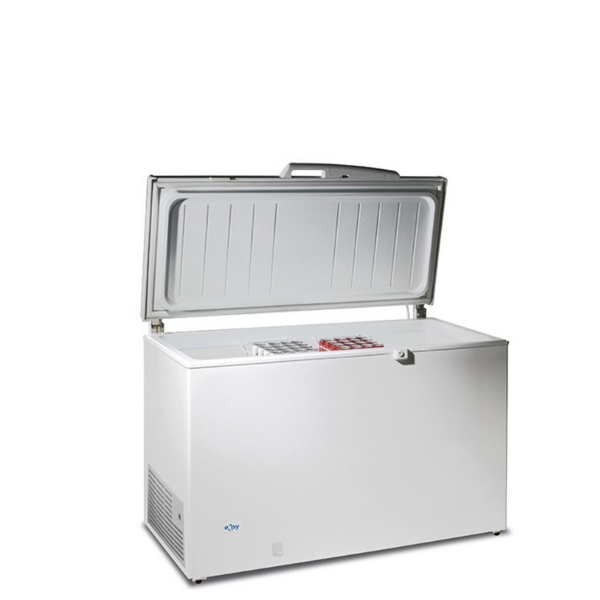
Professional Refrigerated Cabinets: How to Choose Temperature, Capacity and Configuration
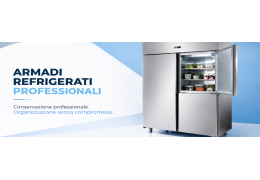
A professional refrigerated cabinet s a central storage appliance for restaurants, hotels, pastry shops, bakeries, pizzerias, cafés, delicatessens and food-production laboratories.
Unlike a domestic refrigerator, it is designed to support intensive workloads, frequent door openings and organised storage suited to commercial foodservice operations.
The selection process should consider operating temperature, usable capacity, refrigeration system, climate class, internal arrangement and the type of food being stored. An incorrectly sized cabinet can slow service, complicate stock rotation and increase energy consumption.
Positive or Negative Temperature
The first distinction concerns the operating-temperature range.
Positive-temperature cabinets are used to store chilled foods. Depending on the model and the business’s procedures, these may include:
-
dairy products;
-
cured meats;
-
fresh meat;
-
fish;
-
fruit and vegetables;
-
beverages;
-
prepared ingredients;
-
ready-made dishes;
-
pastry ingredients.
Negative-temperature cabinets are intended for frozen products under the required storage conditions.
Choosing between positive and negative temperature is not enough. Meat, fish, vegetables, pastry products and gelato ingredients may require different temperature ranges, humidity conditions and storage configurations.
A Cabinet for Each Product Category
Using the same compartment for very different foods can create organisational difficulties, contamination risks and unwanted odour transfer.
When production volume permits, it is useful to divide storage among dedicated cabinets or separate compartments.
A possible organisation may include:
-
meat cabinet;
-
fish cabinet;
-
vegetable cabinet;
-
dairy and cured-meat cabinet;
-
prepared-product cabinet;
-
pastry cabinet;
-
negative-temperature cabinet.
This arrangement must be consistent with the HACCP plan, menu and actual stock volume.
Gross and Usable Capacity
Capacity expressed in litres is an important reference, but it does not always represent the space that can be used in practice.
Usable capacity depends on:
-
insulation thickness;
-
evaporator position;
-
internal runners;
-
shelf arrangement;
-
space occupied by refrigeration components;
-
clearance required for airflow;
-
container formats used.
A cabinet must not be loaded in a way that obstructs air intakes or prevents the even distribution of cold air.
Before purchasing, operators should calculate how many containers, shelves or trays need to be stored instead of relying exclusively on the stated volume.
Compatibility with GN Containers and Trays
Professional cabinetsmay be designed for shelves, Gastronorm containers or bakery and pastry trays.
Compatibility with the formats already used in the laboratory simplifies product transfer between preparation, storage and service.
Important points to check include:
-
internal dimensions;
-
runner format;
-
distance between levels;
-
number of supports supplied;
-
shelf load capacity;
-
possibility of adding more levels;
-
orientation of the containers.
A cabinet compatible with existing equipment reduces unnecessary transfers and improves workflow.
Ventilated or Static Refrigeration
In a ventilated system, fans distribute cold air throughout the compartment. This promotes more uniform temperatures and faster recovery after the door has been opened.
It is particularly useful in busy kitchens where products are stored on several levels and the door is opened frequently.
Ventilation can, however, encourage uncovered foods to lose moisture. Products should therefore be stored in suitable containers or packaging according to the established procedures.
With static refrigeration, air circulates naturally. Temperature differences can develop between areas of the cabinet and must be considered when arranging products.
The correct system depends on the food category, opening frequency and storage method.
Climate Class and Room Temperature
The climate class indicates the environmental conditions within which the cabinet can provide its declared performance.
A commercial kitchen can become extremely warm because of ovens, fryers, dishwashers and other equipment. The average room temperature alone is therefore not sufficient when assessing installation conditions.
Before installation, operators should consider:
-
maximum kitchen temperature;
-
humidity;
-
proximity to heat sources;
-
room ventilation;
-
required clearance from walls and equipment;
-
service intensity;
-
specified climate class.
A cabinet unsuitable for the environment may operate continuously without maintaining the correct temperature, increasing both consumption and component wear.
Insulation Thickness and Quality
Insulation reduces heat transfer between the refrigerated compartment and the surrounding environment.
Its effectiveness influences:
-
temperature stability;
-
recovery time;
-
compressor operating frequency;
-
energy consumption;
-
condensation;
-
performance in warm environments.
The integrity of cabinet walls and door seals is also essential. Damage and deterioration can reduce the appliance’s ability to retain cold air.
One or Two Doors
Single-door cabinets may suit compact kitchens and moderate storage requirements. Two-door models provide greater capacity and can help organise different categories or production batches.
The number of doors should not be confused with the number of independent compartments. On some models, both doors provide access to the same refrigerated space.
Before choosing, it is necessary to evaluate:
-
required capacity;
-
available width;
-
door-opening clearance;
-
frequency of access;
-
internal organisation;
-
need to separate products;
-
door-opening direction.
Separate doors can limit cold-air loss when products are arranged logically.
Solid or Glass Doors
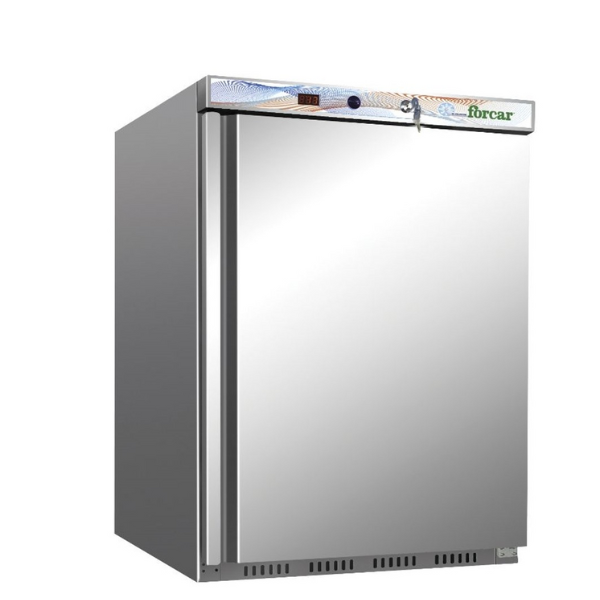
A solid door generally provides effective insulation and protects products from light. It is a common choice in kitchens and food laboratories.
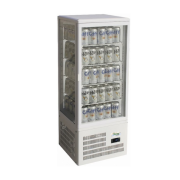
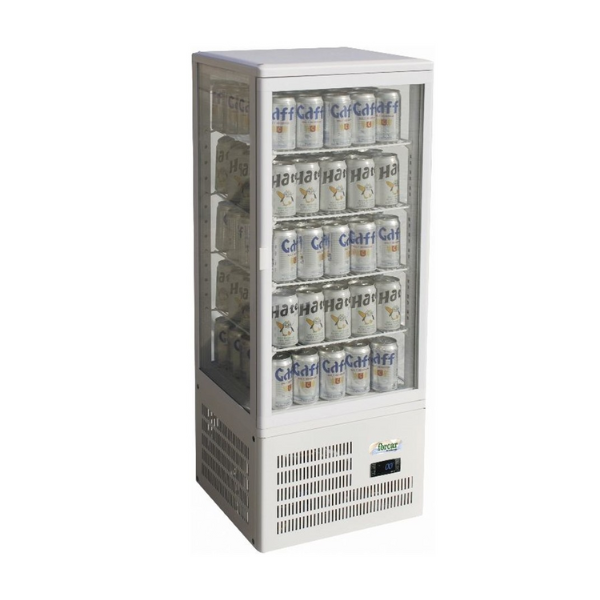
A glass door allows staff to identify the contents without opening the cabinet. This may be useful in bars, service areas and workstations where products need to be located quickly.
Glass surfaces require frequent cleaning and should be evaluated in relation to insulation, room conditions and intended use.
Refrigeration Unit Position
The refrigeration unit may be positioned at the top or bottom of the cabinet.
A top-mounted unit can limit the intake of dust and debris from the floor, but it needs sufficient clearance for ventilation and maintenance.
A bottom-mounted unit may provide convenient technical access, but the surrounding area and air intakes require careful cleaning.
Neither position is universally better. The choice should consider:
-
installation environment;
-
maintenance access;
-
presence of dust or flour;
-
temperature near the ceiling;
-
total height available;
-
ergonomics of the storage area.
Defrosting and Condensate Management
Ice can form on the evaporator during operation. Defrosting removes this build-up and helps maintain efficient heat exchange.
Systems may be automatic or require specific procedures depending on the model.
Operators should verify:
-
type of defrosting;
-
programmable frequency;
-
condensate management;
-
drainage requirements;
-
accessibility of the collection tray;
-
maintenance instructions.
Excessive ice reduces efficiency, restricts airflow and can affect the temperature inside the cabinet.
Digital Control and Alarms
A digital thermostat allows the temperature to be set and displayed. Some models may also provide alarm and recording functions.
Useful features can include:
-
clearly readable display;
-
accurate adjustment;
-
high- and low-temperature alarms;
-
door-open warning;
-
defrost control;
-
connection to monitoring systems.
The value shown on the display does not automatically replace the checks required by the HACCP plan. The business must use appropriate instruments and procedures to monitor and record storage conditions.
Energy Efficiency
A refrigerated cabinet operates for many hours and can have a substantial effect on a business’s energy consumption.
Efficiency depends on:
-
insulation quality;
-
compressor technology;
-
fans;
-
door seals;
-
defrost system;
-
temperature setting;
-
ambient conditions;
-
door-opening frequency;
-
condenser maintenance;
-
loading method.
Declared consumption should be considered together with usable capacity and test conditions. An efficient cabinet may still consume excessive energy when installed near a heat source or operated with damaged seals.
Organising the Contents
Internal organisation affects both food safety and productivity.
Products should be:
-
clearly identified;
-
date labelled;
-
protected;
-
separated by category;
-
arranged according to the stock-rotation system;
-
easily accessible;
-
positioned without obstructing airflow.
Where applicable, the FIFO system helps ensure that older stock is used first. The arrangement must also prevent contact between raw foods and ready-to-eat preparations.
Food should not be placed directly on the cabinet floor unless the design and internal procedure specifically permit it.
Do Not Load Excessively Hot Food
A refrigerated cabinet is designed primarily to store products that have already reached the required conditions. It is not intended to cool large quantities of hot food rapidly.
Loading hot preparations can:
-
increase the temperature inside the cabinet;
-
affect other stored products;
-
generate condensation;
-
extend compressor operation;
-
result in uncontrolled cooling.
Where the process requires rapid cooling, dedicated equipment and procedures, such as a blast chiller, should be used.
Frequent Door Openings and Temperature Recovery
Every door opening introduces warm, humid air. In a busy kitchen, temperature-recovery performance becomes particularly important.
To reduce heat gain, staff should:
-
organise products for quick retrieval;
-
use clearly visible labels;
-
avoid leaving the door open;
-
check the self-closing mechanism where fitted;
-
avoid disorganised loading;
-
inspect the seals regularly.
A well-organised cabinet remains open for less time and helps improve service speed.
Installation and Ventilation Clearance
The cabinet must be positioned on a stable and level surface.
The clearances specified by the manufacturer must be respected to allow:
-
condenser ventilation;
-
full door opening;
-
shelf removal;
-
cleaning at the sides and rear;
-
technical access;
-
heat dissipation.
The appliance should not be installed close to ovens, fry tops, fryers or other heat sources without carefully evaluating the conditions.
After transportation, commissioning must follow the manufacturer’s instructions.
Cleaning the Cabinet
Cleaning should be scheduled regularly and must be compatible with the internal and external materials.
A typical procedure may include:
-
transferring food safely;
-
switching off and disconnecting the cabinet when required;
-
removing shelves and runners;
-
eliminating residues;
-
washing with compatible detergents;
-
rinsing where necessary;
-
sanitising;
-
drying completely;
-
checking drainage and door seals;
-
restarting and verifying the temperature before reloading.
Abrasive chemicals and metal tools can damage stainless steel and internal surfaces.
Preventive Maintenance
Preventive maintenance preserves performance and reduces the risk of equipment failure.
Periodic checks should cover:
-
condenser cleanliness;
-
door-seal integrity;
-
fan operation;
-
door closure;
-
condensate drainage;
-
unusual ice formation;
-
abnormal noise or vibration;
-
temperature stability;
-
condition of cables and connections.
Work on the refrigeration circuit must only be performed by qualified technicians.
How to Choose a Professional Refrigerated Cabinet
Before purchasing, the business should determine:
-
positive or negative temperature;
-
category of food;
-
usable capacity required;
-
GN, shelf or tray formats;
-
ventilated or static refrigeration;
-
climate class;
-
number and type of doors;
-
position of the refrigeration unit;
-
defrost method;
-
control system;
-
installation space;
-
energy consumption;
-
access for cleaning and maintenance.
The most suitable cabinet is not necessarily the one with the greatest number of litres. It is the model that maintains the products correctly and integrates effectively into the business’s workflow.
Related Category on Ristorazione‑Refrigerazione
The selection of professional refrigerated cabinets allows operators to compare positive- and negative-temperature models, solid- and glass-door configurations and solutions for different areas of professional foodservice.
Conclusion
A correctly selected professional refrigerated cabinet protects raw materials, supports stock rotation and improves the efficiency of kitchen operations.
Temperature, usable capacity and climate class must be considered together with the food category and the actual environmental conditions.
Explore the professional refrigerated cabinets available from Ristorazione‑Refrigerazione and contact us to identify the most suitable solution for your business.