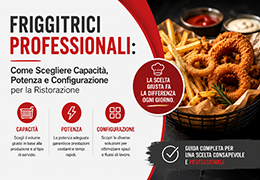
Commercial Deep Fryers: How to Select the Correct Capacity, Power and Configuration
A commercial deep fryer is an essential appliance for restaurants, pizzerias, pubs, bistros, delicatessens, fast-food operations, food trucks, hotels and catering services.
French fries, croquettes, arancini, seafood, vegetables, chicken, snacks and fried desserts all require stable oil temperature, rapid heat recovery and precise frying management. The final result does not depend solely on the recipe: tank capacity, power, batch size and workstation organisation directly influence crispness, colour, cooking time and energy consumption.
To select the most suitable model, operators must evaluate the actual production volume, the foods being fried, the available energy supply, the number of tanks and the procedures used for oil filtration, cleaning and maintenance.
Why Use a Commercial Deep Fryer?
A commercial deep fryer is designed to support more intensive workloads than a domestic appliance.
Its structure, heating system and temperature controls make it possible to process repeated batches throughout service.
The main advantages include:
-
more stable oil temperature;
-
faster heat recovery;
-
greater production capacity;
-
tanks and baskets designed for commercial use;
-
controlled temperature adjustment;
-
more robust construction;
-
better-organised draining and cleaning procedures;
-
availability of separate tanks;
-
more consistent results.
The appliance must still be selected and used correctly. An undersized commercial fryer can lose temperature rapidly and slow down service.
How Deep Frying Works
During deep frying, food is immersed in hot oil. The heat causes the rapid evaporation of surface moisture and encourages the formation of an external crust.
When temperature, time and batch size are correct, the surface becomes dry and crisp while the centre reaches the desired consistency.
If the oil temperature falls excessively:
-
the crust forms more slowly;
-
the product may absorb more oil;
-
cooking times increase;
-
colour can become uneven;
-
output decreases.
An excessively high temperature can darken the surface before the food is cooked correctly at the centre.
Every product requires specific operating parameters. There is no single frying temperature suitable for every preparation.
Tank Capacity and Production Output
Tank capacity is generally expressed in litres. This value indicates the approximate volume of oil the tank can hold, but it does not describe the actual production capacity on its own.
Two fryers with tanks of the same capacity may have different power levels, heating surfaces and recovery times.
To estimate the capacity required, consider:
-
maximum demand during the busiest hour;
-
weight of each portion;
-
average cooking time;
-
number of consecutive batches;
-
type of product;
-
use of fresh or frozen foods;
-
space required between pieces;
-
variety of the menu.
A frozen product introduces a greater thermal load than refrigerated food. Surface ice, excess water and oversized batches can also cause a significant drop in temperature.
Power and Heat Recovery
Power influences the fryer’s ability to heat the oil and recover its temperature after food is loaded.
The highest selectable temperature is not the only important figure. During an intensive service, the speed at which the fryer returns to the selected temperature after each batch is particularly important.
Insufficient heat recovery can cause:
-
longer intervals between batches;
-
less crisp products;
-
increased time in the oil;
-
inconsistent results between the first and final batches;
-
lower productivity.
Power must be evaluated in relation to tank capacity. A large tank with insufficient power may take too long to restore the correct operating conditions.
Electric Deep Fryers
Electric fryers use heating elements to bring the oil to temperature.
They are available as compact countertop models and more powerful floor-standing versions with one or two tanks.
Before purchasing, check:
-
voltage;
-
frequency;
-
connected load;
-
single-phase or three-phase supply;
-
connection type;
-
capacity of the electrical installation;
-
simultaneous operation of other kitchen appliances.
Higher-capacity models may require a three-phase supply. Operators should never assume that every fryer can be connected to an ordinary socket.
Electric fryers can be suitable for all-electric kitchens, small premises, food trucks and businesses without a gas line, provided the electrical installation has enough capacity.
Gas Deep Fryers
Gas fryers use burners to transfer heat to the oil.
Depending on the manufacturer’s configuration, they may operate with natural gas or LPG. Installation, connection and any gas conversion must be completed exclusively by qualified personnel.
Before choosing a gas fryer, evaluate:
-
available gas type;
-
supply pressure;
-
heat output;
-
ventilation;
-
extraction system;
-
combustion-product requirements;
-
position of the isolation valve;
-
compliance of the installation.
A gas fryer can integrate effectively into an existing gas cooking line and support intensive production.
Countertop Models
Countertop fryers are designed to be placed on a stable, heat-resistant commercial worktop.
They can be used in:
-
bars;
-
small bistros;
-
pizzerias;
-
delicatessens;
-
kitchens with limited space;
-
seasonal businesses;
-
operations producing small quantities of fried food.
Before installation, verify the weight of the appliance, working height, stability of the support and required safety clearances.
A compact model is not necessarily low-powered, but the limited capacity of its tank and baskets must be compatible with the number of portions required.
Floor-Standing Models
Floor-standing fryers form a self-contained workstation and can be integrated into a modular cooking line.
They are suitable for restaurants, fried-food businesses, hotels, fast-food outlets and other high-output operations.
The base can simplify access to drains and technical components. Depending on the configuration, some models may accommodate systems or containers used for oil management.
Selection should consider:
-
cooking-line height;
-
depth;
-
utility connections;
-
maintenance access;
-
space for draining and collecting oil;
-
ease of floor cleaning.
Single and Twin Tanks
A single-tank fryer concentrates all production capacity in one area. It can be appropriate for a business that mainly prepares one category of food in large quantities.
A twin-tank fryer allows different products to be managed more efficiently.
The separate tanks can be used to:
-
keep seafood and meat apart;
-
separate savoury and sweet preparations;
-
operate at different temperatures;
-
use different types of oil;
-
activate only the capacity required during quieter periods;
-
limit some flavour transfer.
Twin tanks do not automatically eliminate cross-contamination risks. Utensils, baskets, surfaces and operating procedures must remain consistent with allergen-management requirements.
One Tank with Two Baskets
Some fryers have one tank equipped with two baskets.
This configuration allows separate portions to be cooked simultaneously, but every product enters the same oil.
It is therefore not equivalent to a unit with two independent tanks. Flavours, residues and allergens can be transferred through the shared oil.
One tank with two baskets is useful when dividing batches of the same product or managing similar portions with slightly different cooking times.
The Cold Zone
In some fryers, the tank design creates an area where food particles can settle at a lower temperature than the main cooking zone.
This feature helps limit the continuous burning of residues released by the food.
Effective residue management can help:
-
keep the oil cleaner;
-
reduce burnt flavours and odours;
-
simplify filtration;
-
improve product consistency;
-
maintain the operational quality of the oil.
The cold zone does not replace filtration or cleaning. Residues must still be removed according to a regular procedure.
Drain Tap
A drain tap makes it easier to empty the tank, especially on higher-capacity fryers.
Moving a container filled with hot oil manually can be dangerous. A correctly designed drainage system allows the oil to be transferred into a suitable container in a more controlled manner.
Before operating the tap:
-
switch off the appliance;
-
wait for the conditions specified by the manufacturer;
-
wear appropriate personal protective equipment;
-
use a heat-resistant container;
-
make sure the working area is clear;
-
open the flow gradually;
-
prevent contact with water.
The drain must be cleaned to prevent solid residues from affecting its operation.
Oil Filtration
During frying, breading, flour, crumbs and small food particles collect in the oil. If they are not removed, they continue to heat and can accelerate deterioration.
Filtration separates solid particles and helps maintain more consistent operating conditions.
The required frequency depends on:
-
production volume;
-
type of food;
-
amount of breading;
-
operating temperature;
-
service duration;
-
characteristics of the oil;
-
filtration procedure.
Some fryers can include an integrated filtration system or dedicated accessories. Other models require a safe manual process that complies with the manufacturer’s instructions.
Monitoring Oil Quality
Oil should not be replaced solely according to a fixed timetable or judged only by its colour.
Its deterioration depends on several factors:
-
temperature;
-
total heating time;
-
food residues;
-
contact with water and salt;
-
type of food;
-
oxygen exposure;
-
filtration frequency;
-
addition of fresh oil;
-
tank cleanliness.
During use, staff should monitor changes in odour, viscosity, foaming, smoke and frying behaviour.
Oil control should form part of the business’s food-safety procedures and may be supported by specific instruments that evaluate oil condition.
Adding fresh oil does not automatically make severely deteriorated oil suitable for continued use.
Avoiding Basket Overload
Overfilling the basket causes a rapid decrease in temperature.
Food needs enough space to be surrounded by oil. Pieces packed too closely together can stick and cook unevenly.
For each recipe, it is useful to establish:
-
maximum weight per basket;
-
initial product temperature;
-
oil temperature;
-
cooking time;
-
movement during frying;
-
draining time;
-
final seasoning.
These instructions help standardise production even when different members of staff operate the fryer.
Managing Frozen Products
Frozen foods may have ice on their surface. When water contacts hot oil, it generates a violent reaction with foaming and splashing.
Before frying, staff should:
-
follow the product instructions;
-
remove loose surface ice when possible and appropriate;
-
load controlled quantities;
-
lower the basket gradually;
-
avoid overfilling the tank;
-
keep hands and face away from the oil;
-
reject damaged packages or products with abnormal ice accumulation.
Food should not be thawed in advance when the manufacturer’s instructions require frying from frozen.
Preparing Food Correctly
The condition of the food’s surface affects its behaviour during frying.
Excessively wet products can cause splashing and delay crust formation. Poorly attached breading disperses into the oil, creates additional residue and can produce uneven colour.
Before cooking, it is important to:
-
maintain uniform portions;
-
remove excess surface moisture;
-
allow batter and breading to adhere correctly;
-
remove loose coating;
-
hold products at the required temperature;
-
avoid extended periods on the worktop;
-
separate allergen-containing preparations.
Precise standardisation reduces waste and makes cooking times more predictable.
Seasoning After Frying
Whenever possible, salt should be applied after the product has been moved away from the tank.
Salt entering the oil can contribute to its deterioration and accumulate with the other residues.
After frying, food should drain for the required time and be transferred to a clean container. Seasoning can then be applied evenly before service.
The basket should not be shaken directly over the tank if doing so causes salt, crumbs and fragments to fall into the oil.
Safety During Service
Hot oil is one of the most significant hazards in a commercial kitchen.
The workstation must be organised to prevent impacts, contact with water, congested routes and sudden movement.
Staff should:
-
keep the floor dry;
-
use suitable commercial utensils;
-
wear the required protective equipment;
-
never move a fryer containing hot oil;
-
keep handles and baskets away from walkways;
-
prevent water from contacting the oil;
-
understand all shut-off devices;
-
receive appropriate training;
-
remain within the stated filling limits.
Water must never be used on an oil fire. Emergency procedures and fire-control equipment must comply with applicable requirements and be understood by all operators.
Extraction and Working Environment
Frying generates vapour, odours, heat and airborne grease particles.
The fryer must be installed beneath a correctly sized extraction system, in accordance with technical instructions and applicable requirements.
Effective ventilation helps:
-
improve staff comfort;
-
limit heat accumulation;
-
reduce the spread of odours;
-
control grease deposits;
-
maintain a cleaner environment.
Hood filters and ductwork require regular cleaning and maintenance.
Cleaning the Fryer
Cleaning must only begin when the appliance is in the safe condition specified by the manufacturer.
The procedure generally includes:
-
switching off the appliance;
-
allowing the oil to cool under controlled conditions;
-
draining or filtering the oil;
-
removing solid residues;
-
washing the tank;
-
cleaning baskets and supports;
-
cleaning the drain tap;
-
rinsing, when required;
-
drying completely;
-
cleaning the external surfaces.
Before the tank is refilled, every trace of water must be removed.
Abrasive tools and chemicals that are incompatible with stainless steel or other fryer components must not be used.
Preventive Maintenance
A fryer that receives regular maintenance is more likely to preserve its temperature accuracy, safety and efficiency.
The maintenance programme should include checks on:
-
thermostat;
-
safety limiter;
-
heating elements;
-
burners;
-
ignition system;
-
drain tap;
-
baskets;
-
electrical cables and connections;
-
valves;
-
seals;
-
tank condition.
Longer heating times, unusual temperature changes, abnormal odours or repeated shutdowns should be investigated by a qualified technician.
Organising the Frying Station
A productive frying station should follow a simple and safe sequence:
-
retrieve the prepared portion;
-
load the basket;
-
lower it into the oil carefully;
-
monitor cooking;
-
raise the basket;
-
allow the product to drain;
-
season;
-
transfer to the pass or packaging station;
-
remove food residues.
Raw products, cooked foods, clean utensils and serving containers must remain separate.
The workstation should reduce unnecessary movement and prevent staff from walking across the kitchen while carrying baskets or containers of hot oil.
How to Select a Commercial Deep Fryer
Before purchasing, verify:
-
production required during the busiest hour;
-
portion weight;
-
tank capacity;
-
power and heat recovery;
-
electric or gas supply;
-
single-phase or three-phase connection;
-
single or twin tanks;
-
number and dimensions of the baskets;
-
availability of a cold zone;
-
drain tap;
-
filtration system;
-
countertop or floor-standing configuration;
-
available space;
-
extraction requirements;
-
ease of cleaning and maintenance.
Selection should begin with the menu and service volume. A larger fryer does not automatically provide greater efficiency if its power, batch sizes and workstation organisation are unsuitable.
Related Category on Ristorazione-Refrigerazione
Explore the range of commercial deep fryers available from Ristorazione-Refrigerazione to compare electric and gas models, countertop and floor-standing configurations, single and twin tanks, and different production capacities.
Related Chef Costantino Recipe
Creamed Salt Cod Croquette with Lemon Mayonnaise and Olive Powder
This professional preparation combines a crisp coating with a soft centre of creamed salt cod. Lemon mayonnaise provides freshness, while olive powder completes the dish with a savoury, aromatic note.
The complete recipe will be published on Chef Costantino with quantities per portion, total ingredients, professional procedure, Critical Control Points, allergens, plating instructions and food-cost calculation.
Conclusion
A commercial deep fryer must provide production continuity, heat recovery, safety and straightforward daily management.
Tank capacity, power, energy supply, number of tanks and drainage system should all be evaluated according to the establishment’s actual output. Oil filtration and monitoring, cleaning and staff training are equally important for producing fried food that is dry, crisp and consistent.
To identify the most suitable fryer for your business, explore the dedicated category or contact Ristorazione-Refrigerazione with details of your establishment, the foods being fried, expected peak-hour production and available energy supply.