Senza tasse Con tasse

PASTA MANUFACTURING

Professional fresh pasta making machines are commercial appliances designed to mix, extrude, roll and shape different types of pasta in food production environments. Ideal for artisan pasta shops, restaurants, trattorias, hotels, delicatessens, fresh pasta production facilities, catering companies and commercial kitchens, they support the preparation of tagliatelle, fettuccine, spaghetti, macaroni, lasagne, ravioli and other pasta shapes, depending on the technology and compatible accessories.

The range includes commercial fresh pasta machines, pasta extruders, machines with interchangeable dies, dough sheeters and pizza dough rollers, available in different capacities and configurations. Depending on the model, features may include mixing bowls, extrusion screws, interchangeable pasta dies, pasta cutters, adjustable rollers, electric controls and safety devices. When choosing suitable equipment, consider production capacity in kg/h, dough batch capacity in kilograms, intended pasta shapes, available accessories, electrical supply and workspace requirements.

Commercial fresh pasta machines for restaurants and pasta production facilities

Producing artisan fresh pasta requires equipment suited to the recipes, pasta shapes and production quantities. Professional fresh pasta makers may combine mixing and extrusion through dedicated dies, while pasta dough sheeters use rollers to produce sheets of controlled thickness. Commercial pizza dough rollers are specifically designed to flatten pizza dough portions into bases of the required shape and size.

Main types of professional pasta making equipment

Professional fresh pasta machines

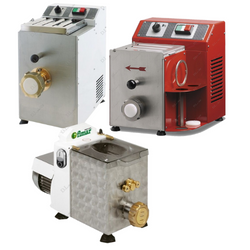
Commercial fresh pasta makers produce different pasta shapes using mixing and extrusion systems, depending on the model. With suitable dies and attachments, they can prepare spaghetti, macaroni, tagliatelle and other pasta varieties. Hourly output and workable batch size depend on the appliance specifications.

Fresh pasta extruders with interchangeable dies

Commercial pasta extruders force suitable dough through dies that determine the shape of the resulting pasta. Depending on the machine and accessories, they can produce short pasta, long pasta and extruded pasta sheets. Dies may be supplied with the machine or sold separately and must be compatible with the relevant attachment system.

Professional pasta dough sheeters

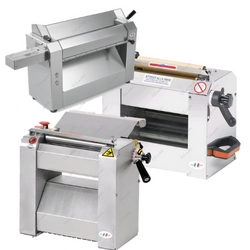
Commercial pasta sheeters use rollers to progressively reduce dough thickness and produce sheets for different preparations. They are used for lasagne, tagliatelle, filled pasta and related products when combined with suitable tools and processes. Roller width, adjustable thickness and operating capacity vary according to the model.

Commercial pizza dough rollers

Professional pizza dough rollers are designed to flatten dough portions for pizza preparation. Depending on the model, they may feature adjustable rollers, electric drive systems and dough thickness controls. Suitable pizza diameter, dough ball weight and roller configuration must be confirmed from the technical specifications.

Pasta cutters, ravioli makers and accessories

Fresh pasta production may require pasta cutters, ravioli makers, extrusion dies and other dedicated accessories. These tools can cut pasta sheets, form ravioli or create different shapes when properly matched to the equipment. Dimensions, attachment compatibility and included accessories should be checked before purchasing.

Countertop and higher-capacity pasta machines

Countertop fresh pasta machines are suitable for specific production volumes and workplaces with limited space. Higher-capacity machines may be intended for pasta workshops and continuous production facilities. Consider mixing bowl capacity, rated kg/h output, single-phase or three-phase supply and production layout when selecting equipment.

How to choose a professional fresh pasta machine

When selecting a commercial pasta maker for a restaurant, pasta shop or delicatessen, identify the pasta shapes to be produced, the quantities required and the characteristics of the dough. A small restaurant making fresh pasta for its menu may have different needs from a facility producing pasta for retail distribution.

Important criteria include hourly production in kg/h, dough bowl capacity in kilograms, motor power, electrical supply, dimensions, cleaning access and available pasta dies. Check which processes the equipment can perform and whether additional accessories must be purchased separately.

Extruded pasta versus sheeted pasta: key differences

Extruded fresh pasta is produced by pushing dough through a die that defines its shape. The process is suitable for many types of pasta, including spaghetti, macaroni and other long or short shapes, depending on the equipment. Dough formulation must be compatible with the extrusion mechanism.

Sheeted fresh pasta is produced by passing dough through rollers until the desired thickness is reached. The resulting sheets can be cut or processed into filled pasta with appropriate equipment. Extrusion and sheeting are different processes, and not every machine can perform both.

Pasta dies, cutters and different pasta shapes

Pasta extrusion dies determine the cross-section and appearance of extruded products. They must be selected according to the desired shape and compatibility with the pasta machine. Depending on the range, dies may be available for long pasta, short pasta and specialised formats. Die dimensions and construction materials vary by equipment.

Pasta cutters, when provided, can determine the length of extruded pasta. Preparing ravioli and other filled pasta may require separate ravioli machines or dedicated forming tools. Purchasing a fresh pasta machine does not automatically mean every pasta shape can be produced without additional accessories.

Batch capacity and hourly production: what do they mean?

Dough capacity in kilograms indicates the quantity processed per batch under the manufacturer's specified conditions, while hourly production in kg/h refers to the theoretical output achievable over one hour. These figures are different, as a machine with a relatively small mixing bowl may complete several batches during a working day.

Actual production depends on recipe formulation, dough consistency, selected die, loading and unloading times and workflow continuity. The minimum permitted load, accessory availability and subsequent pasta handling operations should also be evaluated.

Installation, hygiene and pasta machine maintenance

Installing commercial fresh pasta processing machines requires a stable work surface or suitable floor positioning, compatible single-phase or three-phase electrical supply and enough space for ingredient loading and pasta collection. Certain models may require additional connections, such as a water supply for specific cooling systems.

Maintenance includes cleaning mixing bowls, extrusion screws, dies, rollers and removable attachments according to manufacturer instructions. Cleaning must be carried out with the machine safely stopped. HACCP-based procedures must also be followed for pasta preparation, handling and storage, particularly when recipes contain eggs or other perishable ingredients.

WE ARE HERE TO HELP

Looking for a commercial fresh pasta machine or dough sheeter?

Our team can help you choose fresh pasta makers, extruders, pasta sheeters, pizza dough rollers and compatible accessories based on hourly output, batch capacity, desired pasta shapes, dimensions and electrical supply. Contact us by telephone, WhatsApp, online chat, email or request a video consultation.

Choose how to contact us →

Product added to compare.