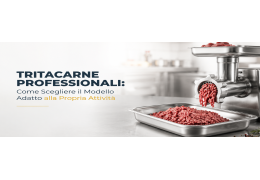
Professional Meat Grinders: How to Choose the Right Model for Your Business
A professional meat grinder is an essential appliance for butcher shops, restaurants, burger businesses, delicatessens, food laboratories and institutional catering facilities. It enables operators to process meat directly, control the composition of each preparation and obtain the most suitable texture for the final product.
Burgers, meatballs, ragù, fillings, sausages and many other recipes can be prepared more consistently when the machine is selected according to the actual production requirements of the business.
Hourly output, motor power, electrical supply, feed opening and construction materials are some of the main factors that should be evaluated before purchasing a professional meat grinder.
Why Use a Professional Meat Grinder?
Processing meat in-house allows the operator to select the cuts, determine the proportion of fat and produce a mixture that matches the required recipe.
The main operational benefits include:
-
direct control over raw materials;
-
consistent grinding size;
-
customised preparations;
-
reduced manual processing time;
-
standardised portions;
-
greater production flexibility;
-
better use of different cuts of meat.
These benefits can only be achieved by maintaining the cold chain and using a machine correctly sized for the expected workload.
Hourly Output and Production Volume
The production capacity of a meat grinder is generally expressed in kilograms of meat processed per hour. This figure is useful when comparing machines, but it should not be considered on its own.
Actual output may vary according to:
-
type and consistency of the meat;
-
size of the pieces being loaded;
-
amount of connective tissue;
-
product temperature;
-
diameter of the grinding plate;
-
continuity of feeding;
-
correct preparation of the raw material.
A small restaurant producing a limited number of burgers has different requirements from a butcher shop or food laboratory processing large quantities throughout the day.
An undersized machine may cause delays, overheating and premature wear. An unnecessarily large model, on the other hand, can take up valuable space and consume energy without providing a genuine production advantage.
Motor Power and Continuous Operation
Motor power must be suitable for the size of the grinding unit and the intended workload. A machine used frequently must be able to process the required quantity without losing speed or placing excessive strain on the motor.
The model with the highest power rating is not automatically the best choice. It is also necessary to evaluate:
-
output stated by the manufacturer;
-
permitted operating cycles;
-
transmission system;
-
motor protection devices;
-
availability of a reverse function;
-
electrical supply required.
A reverse function can help release material from the grinding unit if a blockage occurs, provided that the procedure described in the manufacturer’s manual is followed.
Single-Phase or Three-Phase Power Supply
Compact meat grinders are often available with a single-phase connection, making them suitable for many restaurants, delicatessens and small food laboratories.
Higher-capacity models may require a three-phase connection. Before purchasing, operators should therefore check:
-
voltage;
-
frequency;
-
total power consumption;
-
connection or plug type;
-
capacity of the electrical system;
-
planned installation position.
The connection should be checked by qualified personnel, especially when the meat grinder is installed in a laboratory containing several high-powered appliances.
Stainless Steel and Food-Contact Materials
All components that come into contact with meat must be manufactured from materials suitable for food use, resistant to corrosion and easy to clean.
Stainless steel is widely used for the body, hopper and several parts of the grinding assembly. Some models may use specific food-grade alloys for particular components.
Before choosing a machine, it is useful to check:
-
body material;
-
hopper material;
-
composition of the grinding assembly;
-
ease of component removal;
-
compatibility with approved detergents;
-
manufacturer’s washing instructions.
A stainless-steel exterior does not necessarily mean that every internal component is made from the same material. The technical specification should always be examined carefully.
Enterprise and Unger Grinding Systems
Enterprise and Unger are among the most common grinding-system configurations.
An Enterprise system generally consists of an auger, knife and perforated plate. It is a straightforward and versatile solution suitable for many restaurants, delicatessens and small food laboratories.
An Unger system may contain several cutting elements positioned in sequence. Depending on its configuration, it provides progressive processing and can be suitable for more intensive production or applications requiring a particularly consistent grind.
The decision should be based on the desired result, the product being processed and the daily production volume, rather than simply on the number of components.
Hole Diameter and Grinding Texture
The perforated plate determines the final size of the minced meat. Larger holes produce a coarse texture, while smaller diameters create a finer and more uniform result.
The texture should be chosen according to the preparation:
-
coarse grind for burgers with a clearly defined structure;
-
medium grind for meatballs and certain fillings;
-
fine grind for smooth mixtures and specialised products.
A second pass can produce a finer texture, but the meat must remain at the correct temperature throughout the process. Repeated grinding without adequate control can warm the mixture, damage its consistency and cause the fat to separate.
Preparing the Meat Correctly
The meat must be deboned and unsuitable hard parts removed before it is placed in the grinder. Bones, hard fragments and foreign objects can damage the cutting assembly and create a safety risk.
Operators should:
-
select and inspect the raw material;
-
remove bones and excessively hard tissue;
-
cut the meat into pieces suitable for the feed opening;
-
keep the meat refrigerated;
-
prepare quantities appropriate for each processing cycle;
-
use only the pusher supplied with the machine.
The meat must never be pushed into the feed opening with hands, knives or improvised utensils.
Temperature Control
Grinding increases the exposed surface area of the product and can generate heat through friction. Temperature management is therefore one of the most important aspects of the entire process.
Meat, fat and the other recipe components must remain within the conditions established by the business’s HACCP plan. The grinder does not replace refrigeration, and processed meat must not be left at room temperature unnecessarily.
A professional workflow should include:
-
removing only the required quantity from refrigeration;
-
preparing the meat quickly;
-
grinding without avoidable interruptions;
-
transferring it immediately to a clean food-grade container;
-
refrigerating or using it according to the established procedure;
-
recording the relevant checks when required.
Temperature should be verified using suitable instruments and according to the food-safety management system of the business.
Safety During Operation
A meat grinder contains moving parts and sharp cutting components. Operators must receive suitable training and understand how to use the controls correctly.
During operation, it is essential to:
-
use the original pusher;
-
keep hands away from the feed opening;
-
never remove guards or safety devices;
-
avoid clothing or accessories that could become caught;
-
disconnect the electrical supply before dismantling the machine;
-
wait for all components to stop completely;
-
avoid unauthorised technical interventions.
Blockages must only be managed by following the manufacturer’s instructions.
Dismantling, Cleaning and Sanitising
Meat can leave residues inside the auger, knife and perforated plate. Incomplete cleaning can encourage contamination, unpleasant odours and deterioration in product quality.
At the end of production, operators should:
-
switch off and disconnect the appliance;
-
remove the detachable parts according to the manual;
-
eliminate visible residues;
-
wash the components using compatible products;
-
rinse them when required;
-
sanitise them according to the HACCP plan;
-
dry every component thoroughly;
-
reassemble the grinder or store its components hygienically.
The motor body must not be immersed or cleaned with water jets unless the manufacturer specifically allows this procedure.
The knife and plate should also be inspected regularly. Worn or incorrectly fitted components may crush the meat rather than cutting it cleanly.
Organising the Workstation
The meat grinder should be positioned on a stable, strong and easily sanitised surface. There must be enough space around the machine to load the hopper, collect the processed product and remove the components safely.
An efficient workstation should include:
-
nearby refrigerated storage;
-
a dedicated preparation surface;
-
clean food-grade containers;
-
temperature-monitoring equipment;
-
a separate area for the finished product;
-
easy access for cleaning.
An organised workflow reduces unnecessary movement and limits the amount of time the meat remains outside refrigeration.
How to Choose a Professional Meat Grinder
Before purchasing a machine, the business should clearly determine:
-
kilograms processed each day;
-
output required during peak periods;
-
type of meat and preparations planned;
-
desired grinding texture;
-
preferred cutting system;
-
available electrical supply;
-
available counter space;
-
frequency of dismantling and cleaning;
-
accessories required.
The most suitable meat grinder is not necessarily the model with the highest capacity. It is the one that can complete the required production safely, consistently and efficiently within the kitchen’s operational structure.
Related Category on Ristorazione‑Refrigerazione
The selection of professional meat grinders allows operators to compare machines with different capacities, features and configurations for restaurants, butcher shops, delicatessens and food-production laboratories.
Conclusion
A correctly sized professional meat grinder allows a business to control raw materials more effectively, customise recipes and improve production efficiency.
The final quality also depends on correct meat preparation, temperature management, sharp cutting components and thorough sanitation after every production cycle.
Explore the professional meat grinders available from Ristorazione‑Refrigerazione and contact us to identify the most suitable solution for your production requirements.