Commercial Pizza Ovens: How to Select Capacity, Energy Supply and Cooking Configuration
The oven is the production centre of a pizzeria. Its ability to reach and maintain high temperatures, recover heat after the door is opened and distribute energy correctly between the top and the deck directly affects pizza quality and service speed.
Traditional pizzerias, pizza-by-the-slice businesses, restaurants, pubs, bistros, bakeries, hotels and fast-casual venues can have very different requirements. The correct oven is not simply the model with the largest chamber or highest maximum temperature. It must be sized according to pizza style, diameter, order volume and production workflow.
Before purchasing, operators should evaluate the energy supply, chamber capacity, deck material, power, independent heat control, number of chambers and installation requirements.
The Oven as the Centre of Production
The pizza line should be organised around the oven.
Dough, toppings, refrigerated preparation counter, stretching area, pizza peels and cutting station should be positioned to reduce unnecessary movement and maintain a continuous workflow.
An efficient sequence includes:
-
retrieving the dough ball;
-
stretching;
-
adding the toppings;
-
loading the oven;
-
monitoring and rotating;
-
removing the pizza;
-
finishing;
-
cutting or serving.
If the oven cannot support the number of pizzas required during the busiest hour, the entire line slows down. If it is oversized, it may occupy unnecessary space and consume more energy than the business requires.
Start with the Pizza Style
Different pizzas require different cooking conditions.
Selection should consider:
-
pizza style;
-
dough hydration;
-
dough-ball weight;
-
diameter;
-
thickness;
-
quantity and moisture content of the toppings;
-
cooking temperature;
-
expected cooking time;
-
use of trays or direct deck baking.
A thin round pizza requires different heat management from a contemporary pizza with a pronounced crust. Pizza by the slice, focaccia and tray-baked products also require suitable chamber height and heat distribution.
Defining the main product makes it easier to evaluate temperature, power and chamber dimensions correctly.
Stated Capacity and Real Usable Space
Capacity is often described by the number of pizzas and their diameter.
An oven advertised for four 33 cm pizzas should provide enough space not only to hold them, but also to allow the operator to load, monitor and rotate them.
Actual capacity depends on:
-
real pizza diameter;
-
chamber shape;
-
position of the heating elements;
-
space between pizzas;
-
peel dimensions;
-
need for rotation;
-
operator experience.
Completely filling the deck can restrict movement and slow down service.
Capacity should therefore be assessed under real working conditions rather than by considering only the stated maximum number.
Calculating Peak-Hour Production
To size an oven correctly, estimate how many pizzas must be cooked during the busiest period.
The calculation can include:
-
maximum orders per hour;
-
pizzas loaded simultaneously;
-
average cooking time;
-
loading and unloading time;
-
temperature recovery;
-
proportion of takeaway orders;
-
production of focaccia or tray-baked products.
If one chamber holds six pizzas and each complete cycle requires several minutes, theoretical output must be reduced to account for door opening, pizza rotation, differences between toppings and order management.
A suitable oven should support peak periods without remaining continuously overloaded.
Heat Recovery
Every time the door opens, heat escapes. Loading several pizzas also removes energy from the deck and chamber.
Heat recovery describes the oven’s ability to return rapidly to the selected operating conditions.
If recovery is insufficient:
-
cooking times increase;
-
the base may remain pale;
-
cooking becomes inconsistent;
-
output decreases;
-
results change throughout service.
Maximum temperature is therefore not the only figure to evaluate. Power, insulation, deck mass and the control system all influence production continuity.
Electric Pizza Ovens
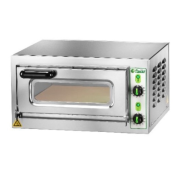
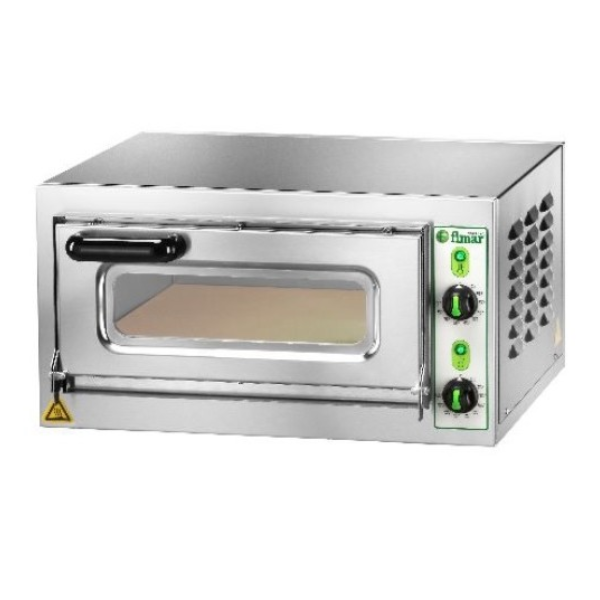
Electric pizza ovens generally use heating elements positioned above and below the chamber.
Independent control of the top and bottom heat allows the operator to balance the baking of the surface, crust and base.
Before purchasing, verify:
-
voltage;
-
frequency;
-
total connected load;
-
single-phase or three-phase supply;
-
maximum current demand;
-
connection type;
-
capacity of the electrical installation;
-
simultaneous operation of other appliances.
Larger and more powerful models often require a three-phase connection. The available electrical capacity should be checked by a qualified technician before ordering.
Electric ovens can be suitable for pizzerias, restaurants and other venues requiring precise control or operating without a gas line.
Gas Pizza Ovens
Gas pizza ovens use burners to generate heat inside the chamber.
Depending on the model and manufacturer’s configuration, they may operate with natural gas or LPG.
Before installation, verify:
-
gas type;
-
supply pressure;
-
heat output;
-
ventilation;
-
combustion-product requirements;
-
extraction system;
-
position of the isolation valve;
-
compliance of the gas installation.
Installation, commissioning and any gas conversion must be performed exclusively by qualified personnel.
A gas oven may be particularly appropriate for a kitchen already organised around a gas cooking line.
Refractory Baking Deck
A refractory deck stores heat and transfers it directly to the pizza base.
This surface supports:
-
development of the base;
-
evaporation of moisture;
-
crust formation;
-
consistent baking;
-
recovery between loads.
Its behaviour depends on its thickness, material and operating temperature.
A deck that is too hot for the recipe can burn the base before the top is ready. A deck that is not hot enough may produce a pale pizza with insufficient structure.
Management should be adapted to dough hydration, the amount of flour beneath the pizza and the intended cooking time.
Independent Top and Bottom Heat Control
The ability to control the top and bottom heat separately helps correct the balance of the bake.
More energy from the deck supports the base, while the upper heat acts on the crust, toppings and surface.
The settings should consider:
-
pizza style;
-
position inside the chamber;
-
oven load;
-
starting temperature;
-
frequency of door opening;
-
topping moisture;
-
desired colour.
There is no universal ratio. Every pizzeria should establish its own parameters through controlled tests.
Single-Chamber Ovens
A single-chamber oven may be sufficient for small businesses, restaurants with a limited pizza menu or operations with moderate production.
Possible advantages include:
-
smaller footprint;
-
straightforward management;
-
lower initial investment;
-
simpler installation requirements than larger configurations.
Capacity must still support peak production.
If the oven is also used for focaccia, trays or other products, operators should assess whether different temperatures and cooking times could interfere with pizza service.
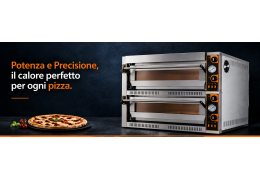
Twin-Chamber Ovens
Stacked chambers increase capacity without fully doubling the floor space.
They can be used to:
-
increase production;
-
operate at different temperatures;
-
separate round pizza from tray-baked products;
-
activate one chamber during quieter periods;
-
manage takeaway orders more effectively;
-
provide additional operational capacity.
Before purchasing, verify the total power required when both chambers operate simultaneously.
Loading height should also be ergonomic and allow pizza peels to be used safely.
Modular and Stackable Ovens
Some pizza ovens allow a compatible second chamber to be added.
This option can be useful for a business expecting gradual production growth.
Stacking must be explicitly permitted by the manufacturer. Supports, connections, clearances and extraction must comply with the approved configuration.
Two appliances should never be placed one above the other without confirming stability, heat dissipation and technical access.
Chamber Height
Internal height should correspond to the products being baked.
A low chamber concentrates heat and may be suitable for round pizza. A taller chamber provides greater flexibility for trays, focaccia and products requiring more vertical development.
A chamber that is unnecessarily tall for the main production may require more energy to maintain the desired conditions.
Height should therefore not be selected solely to obtain theoretical versatility.
Door and Visual Control
The door should limit heat loss while allowing rapid loading.
A viewing window helps the operator monitor the bake without repeatedly opening the chamber. Internal lighting can also support the evaluation of colour and development.
Operators should check:
-
opening dimensions;
-
hinge strength;
-
handle quality;
-
internal visibility;
-
ease of cleaning;
-
door insulation.
Frequent or prolonged opening can reduce temperature and slow down service.
Mechanical and Digital Controls
Mechanical controls provide immediate, straightforward operation.
Digital systems may offer more precise settings, temperature displays, programmes and differentiated power management, depending on the model.
Selection should consider:
-
production variety;
-
required standardisation;
-
number of operators;
-
need to save programmes;
-
preferred level of simplicity;
-
monitoring procedures.
An advanced control panel is useful only when staff are trained and use the available functions correctly.
Rotating Pizzas
In static ovens, different areas of the chamber may behave slightly differently.
The operator should understand:
-
hotter areas;
-
conditions near the door;
-
heat distribution across the deck;
-
upper-heat intensity;
-
effect of a full load.
Pizzas may need to be rotated to achieve even browning.
The chamber should not be filled so completely that the peel cannot be used safely or pizzas overlap during movement.
Rotating-Deck Pizza Ovens
Some models use a rotating deck to move pizzas through the chamber.
This system can reduce manual rotation and support more consistent baking, particularly in high-output operations.
Before selection, consider:
-
capacity;
-
deck diameter;
-
rotation speed;
-
accessibility;
-
cleaning;
-
maintenance;
-
energy consumption;
-
staff skills.
A rotating deck does not replace correct recipe, load and temperature management.
Moisture in the Toppings
Very moist toppings can slow surface cooking and affect the base.
Mozzarella, vegetables, mushrooms, tomatoes and ingredients stored in liquid should be prepared correctly.
It may be necessary to:
-
drain mozzarella;
-
precook some vegetables;
-
dry ingredients;
-
control sauce quantity;
-
distribute toppings evenly;
-
add selected ingredients after baking.
Standardising topping quantities reduces differences between pizzas.
Flour and Residues on the Deck
Excess flour used during stretching can fall onto the refractory deck and burn.
Carbonised residues create smoke, unpleasant odours and bitter flavours on the bases of subsequent pizzas.
During service, the deck should be cleaned periodically with suitable tools that are compatible with its material.
Water and detergents should not be used on a hot deck unless specifically permitted by the manufacturer.
The quantity of flour or semolina should already be controlled during stretching.
Preheating
The oven should be switched on early enough for both the chamber and deck to reach real thermal stability.
The displayed temperature may refer to the air or a specific sensor point and does not necessarily indicate that the entire refractory mass is ready.
Preheating time depends on:
-
dimensions;
-
power;
-
deck thickness;
-
insulation;
-
initial temperature;
-
selected programme.
Beginning service with an unstable deck can produce pale first pizzas and inconsistent cooking times.
Managing Quieter Periods
Keeping every chamber at maximum temperature during long inactive periods can increase energy consumption.
On models with independent chambers, production can be organised by activating only the required capacity, in accordance with the manufacturer’s instructions and the necessary preheating time.
Planning must prevent a chamber from being switched on too late when demand starts to increase.
Sales data can help identify the busiest days and time periods.
Extraction and Ventilation
Pizza ovens produce heat and vapour, as well as combustion products when gas-fired.
Installation must include extraction and ventilation suitable for the model, output and applicable requirements.
Before purchasing, verify:
-
hood requirements;
-
distance from heat-sensitive materials;
-
heat dissipation;
-
air replacement;
-
flue route;
-
room temperature;
-
maintenance access.
Insufficient ventilation can reduce staff comfort and affect other equipment operating in the same kitchen.
Stand and Working Height
The oven must be installed on a stable, heat-resistant stand approved for its total weight.
Its height should allow the operator to see inside the chamber and handle the peel without adopting an unsafe position.
On twin-chamber ovens, the upper deck should not be so high that loading becomes difficult.
The stand may be open or designed for tray organisation, depending on the model and safety requirements.
Daily Cleaning
Cleaning must follow the manufacturer’s instructions and should begin only when the appliance is in the specified safe condition.
Tasks may include:
-
removing residues from the deck;
-
cleaning the chamber;
-
cleaning the door and glass;
-
wiping the external surfaces;
-
inspecting seals;
-
cleaning ventilation openings;
-
removing flour from beneath and around the oven.
Unauthorised chemicals or quantities of water should not be used on a refractory deck.
Peels and brushes should be cleaned separately and maintained in good condition.
Preventive Maintenance
Regular checks help preserve performance and safety.
The maintenance programme should cover:
-
heating elements;
-
burners;
-
thermostats;
-
temperature probes;
-
controls;
-
cables and connections;
-
doors and hinges;
-
seals;
-
internal lighting;
-
refractory-deck condition;
-
ventilation;
-
safety systems.
Longer heating times, temperature differences, unexpected shutdowns or suddenly inconsistent baking should be investigated by qualified personnel.
Standardising the Bake
For each pizza style, it is useful to create an operating sheet that records:
-
dough-ball weight;
-
diameter;
-
hydration;
-
amount of tomato;
-
amount of mozzarella;
-
weight of the other toppings;
-
upper-heat setting;
-
deck-heat setting;
-
position in the chamber;
-
baking time;
-
rotation, when required;
-
finishing after baking.
Standardisation allows results to be compared and reduces differences between operators.
The time between stretching, topping and loading should also be controlled.
How to Select a Commercial Pizza Oven
Before purchasing, evaluate:
-
pizza style;
-
diameter;
-
pizzas required during the busiest hour;
-
average cooking time;
-
chamber capacity;
-
maximum temperature;
-
power and heat recovery;
-
electric or gas supply;
-
single-phase or three-phase connection;
-
one or two chambers;
-
refractory deck;
-
independent top and bottom control;
-
internal height;
-
available space;
-
extraction, ventilation and installation requirements.
The oven should be selected according to actual production, with a reasonable margin for the busiest periods.
Related Category on Ristorazione-Refrigerazione
Explore the selection of commercial pizza ovens available from Ristorazione-Refrigerazione to compare electric and gas models, one- and two-chamber ovens, different capacities and configurations for pizzerias, restaurants, pubs and food-service businesses.
Related Chef Costantino Recipe
Gourmet Diavola Pizza with Spicy Spianata, Fior di Latte, Chilli Honey and Red Onion
This contemporary pizza combines the savoury intensity of spicy spianata with creamy fior di latte and the sweet heat of chilli honey. Marinated red onion provides freshness and aromatic contrast.
The complete recipe will be published on Chef Costantino with quantities per portion, total ingredients, professional procedure, Critical Control Points, allergens, plating instructions and food-cost calculation.
Conclusion
A commercial pizza oven must provide stability, heat recovery, capacity and baking control.
Selection should begin with pizza style, diameter and the output required during the busiest hour. Energy supply, number of chambers, power, deck material and independent top and bottom heat control should be evaluated together.
To identify the most suitable oven for your business, explore the dedicated category or contact Ristorazione-Refrigerazione with details of the pizza style, diameter, expected peak-hour production, available space and energy supply.