Professional Soup Kettles and Food Warmers: Managing Soups, Cream Soups and Hot Dishes in Autumn
This is where professional soup kettles and food warmers become particularly useful.
These appliances are designed to support the holding and service of hot preparations according to the specifications and intended use of each model.
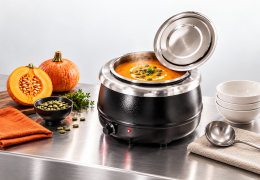
What is a professional soup kettle?
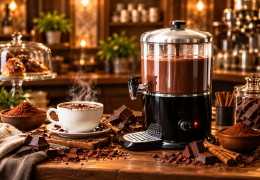
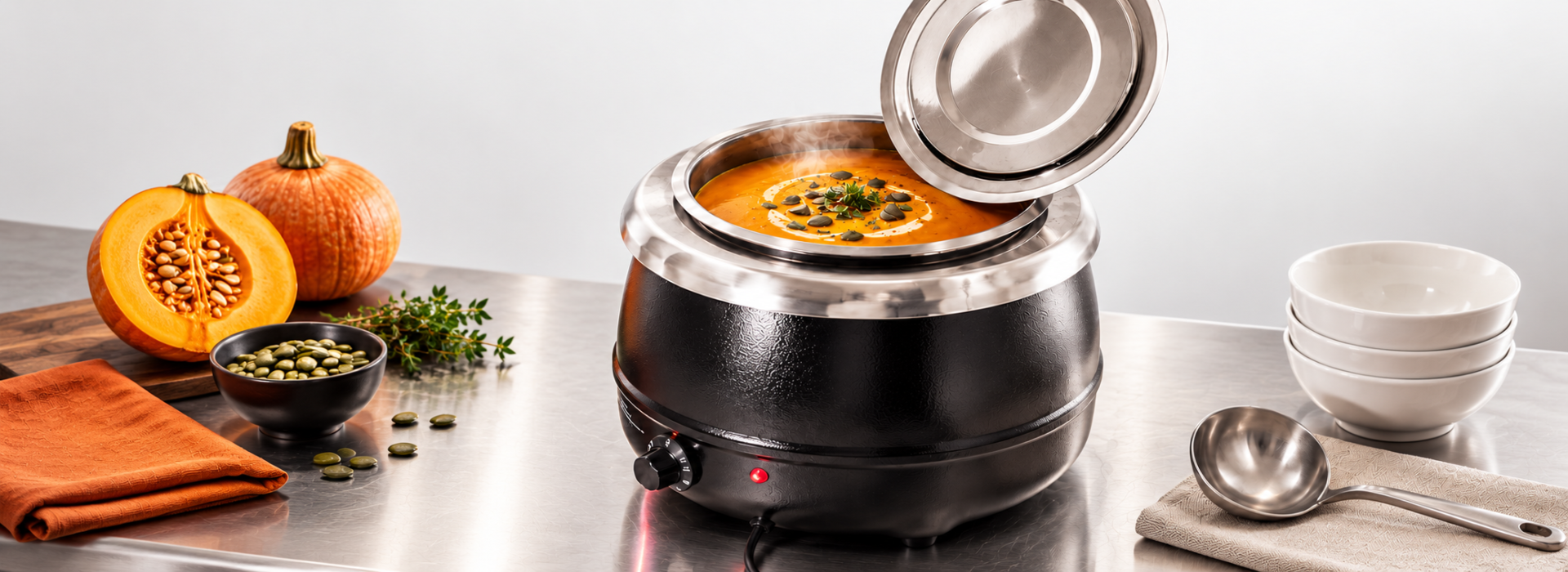
A heated professional soup kettle is generally used to hold and serve liquid or semi-liquid preparations.
Depending on the model, it may be suitable for:
- soups;
- cream soups;
- vegetable purées;
- broths;
- certain sauces;
- other preparations compatible with the appliance.
It is important to distinguish hot holding from cooking.
A professional soup kettle should not automatically be considered an appliance designed to cook food from raw. Always check the functions specified by the manufacturer.
What are professional food warmers?
Food warmers include several types of equipment designed to help maintain prepared food at the required conditions during service.
Depending on the model, they can be used in:
- buffets;
- hotels;
- restaurants;
- catering operations;
- canteens;
- delicatessens;
- self-service restaurants;
- events.
Models can vary considerably in capacity, construction, heating system and operating method.
The choice should therefore begin with the actual service requirements of the business.
Why are they particularly useful in autumn?
As temperatures fall, customers naturally become more interested in warm, comforting dishes.
Consider an autumn buffet offering:
🎃 pumpkin cream soup
🍄 mushroom soup
🥣 legume soup
🥔 potato and leek cream
🌰 chestnut soup
🥕 vegetable purée
All these preparations have something in common: they need to reach the customer in conditions appropriate to the service.
Hot holding therefore becomes an integral part of kitchen organisation.
Holding hot is not the same as continuing to cook
This distinction is essential.
The purpose of hot-holding equipment is to maintain food appropriately during service, not to continue cooking it indefinitely.
Excessive holding times or incorrect management can affect:
- texture;
- colour;
- structure;
- aroma;
- perceived quality.
A cream soup, for example, can gradually change consistency if it is managed incorrectly.
Equipment, production quantity and service time should therefore be planned together.
Soup kettles for hotels and buffets
One of the most natural applications for a professional soup kettle is the buffet.
Hotels can use these appliances during appropriate services to present hot preparations in an organised and accessible way.
Design may also be important.
In a customer-facing buffet, the equipment becomes part of the presentation.
It is therefore useful to evaluate:
- capacity;
- dimensions;
- ease of use;
- accessibility;
- opening system;
- cleaning;
- overall appearance.
Catering and events
Thermal management can become even more important in catering operations.
Food may be prepared in one kitchen and subsequently served in another area.
The entire workflow therefore needs to be planned carefully.
A food warmer alone does not solve every issue related to food temperature. It must form part of a correctly organised system covering preparation, any necessary transport, holding and service.
Choosing the right capacity
Capacity should reflect the number of portions and the speed of service.
Equipment that is too small may require constant refilling.
Excessive capacity, on the other hand, may result in unnecessarily large quantities of food being held for long periods.
The right question is therefore not:
“What is the largest soup kettle available?”
but:
“How much soup do I actually need during each stage of service?”
Temperature management
Temperature control is one of the characteristics to compare when evaluating different appliances.
Not every preparation behaves in the same way.
A thick pumpkin cream and a more liquid soup can react differently during holding.
Equipment should always be operated according to the manufacturer's instructions and the business's HACCP procedures.
Construction and materials
Professional food-service equipment should also be evaluated from a construction perspective.
Important factors include:
- robustness;
- materials used in relevant areas;
- ease of cleaning;
- stability;
- practicality;
- accessibility of components requiring cleaning.
Equipment used every day should fit easily into the operational routine.
Cleaning
Cleaning procedures should follow the instructions for the specific model.
Food residues should not be allowed to remain on relevant surfaces.
Particular attention should be given to food-contact areas and removable components.
Safety instructions must always be followed before cleaning or maintenance.
Energy consumption
Rated power is only part of the calculation.
Food warmers can remain in operation for significant periods during service.
A useful general assessment considers:
power × operating time × frequency of use.
Equipment should therefore be sized according to actual operational requirements.
Presentation matters
In a modern buffet, equipment has both a practical and visual role.
Customers see the counter, containers, warmers and arrangement of the food.
A well-organised hot-food area communicates:
- order;
- attention to detail;
- professionalism;
- consistency.
This can be particularly relevant for hotels, catering services and customer-facing buffets.
Turning soup into an autumn menu item
Soup does not have to be treated as a basic or secondary dish.
Contemporary cooking can transform a simple cream soup into a refined menu item.
Consider a pumpkin and chestnut cream soup, finished with rosemary, toasted seeds, croutons or another crisp element.
Seasonality can therefore become a commercial opportunity: familiar ingredients and careful presentation can create an attractive proposition for customers.
Chef Costantino's related recipe
For this theme, Chef Costantino proposes:
Pumpkin and Chestnut Cream Soup with Rosemary and Crispy Bread.
It uses distinctly autumnal ingredients and demonstrates how a seemingly simple preparation can be developed through texture, aroma and presentation.
How to choose a professional soup kettle
Consider:
Capacity
It should match the quantity normally served.
Intended use
Hotels, buffets, catering operations and restaurants may have different requirements.
Controls
Check the adjustment options offered by the model.
Ease of service
Staff should be able to use it efficiently.
Cleaning
Evaluate construction and removable components.
Dimensions
The equipment must fit the available space.
Design
Especially relevant when customers can see the equipment.
How to choose a professional food warmer
Start with the food and the service.
Ask:
- What preparations will I hold?
- How many portions?
- For how long?
- Will customers see the equipment?
- How much space is available?
- Does it need to be moved frequently?
- Which containers are used?
- How will it be cleaned?
Only after answering these questions should different models be compared.
Common mistakes
Typical mistakes include:
- choosing excessive capacity;
- confusing hot holding with cooking;
- filling equipment without considering turnover;
- failing to manage temperature appropriately;
- unnecessarily long holding times;
- overlooking HACCP procedures;
- underestimating cleaning requirements;
- selecting equipment based only on price.
FAQ – Professional Soup Kettles and Food Warmers
What is a professional soup kettle used for?
It is generally designed to hold and serve soups, cream soups and other preparations compatible with the appliance.
Does a soup kettle cook soup?
Not necessarily. Many models are primarily intended for holding. Always check the manufacturer's specifications.
Where are professional food warmers used?
Restaurants, hotels, buffets, catering operations, canteens, delicatessens and many other professional environments.
How should I choose capacity?
According to portion numbers, service speed and refill strategy.
Can any food be used?
Compatibility with the specific equipment and manufacturer's instructions should always be checked.
Are they suitable for buffets?
Many models are designed for buffet applications, although intended use varies between products.
Does temperature need to be monitored?
Yes. Temperature management must form part of the business's food-safety procedures.
How much electricity does a food warmer consume?
It depends on power, operating time and frequency of use.
Conclusion
As autumn arrives, soups, cream soups and hot preparations become increasingly important for many food-service businesses.
Preparing the food correctly is only the first stage.
Holding, presentation and service must also be organised properly.
Professional soup kettles and food warmers can help create a more functional hot-food service according to the needs of the business.
👉 Discover professional soup kettles, food warmers and hot-service equipment available from Ristorazione-Refrigerazione.
TAGS
professional soup kettles, commercial soup kettles, professional food warmers, hot holding equipment, buffet equipment, catering equipment, hotel buffet, soups, cream soups, autumn menu, professional kitchen, restaurant equipment, HoReCa