Professional Rotisserie Ovens: Organising Roast Chicken Production and Sales in Food-Service Businesses
For rotisserie shops, delicatessens, supermarkets, restaurants, butcher shops with cooking facilities and takeaway businesses, a professional rotisserie oven can become the centre of a dedicated production line.
Choosing one involves more than simply calculating how many chickens will fit inside.
Capacity, energy source, number of spits, production cycles, cleaning requirements and actual sales volumes should all be evaluated together.
What is a professional rotisserie oven?
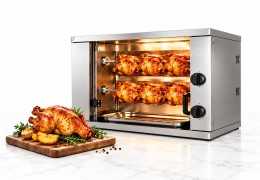
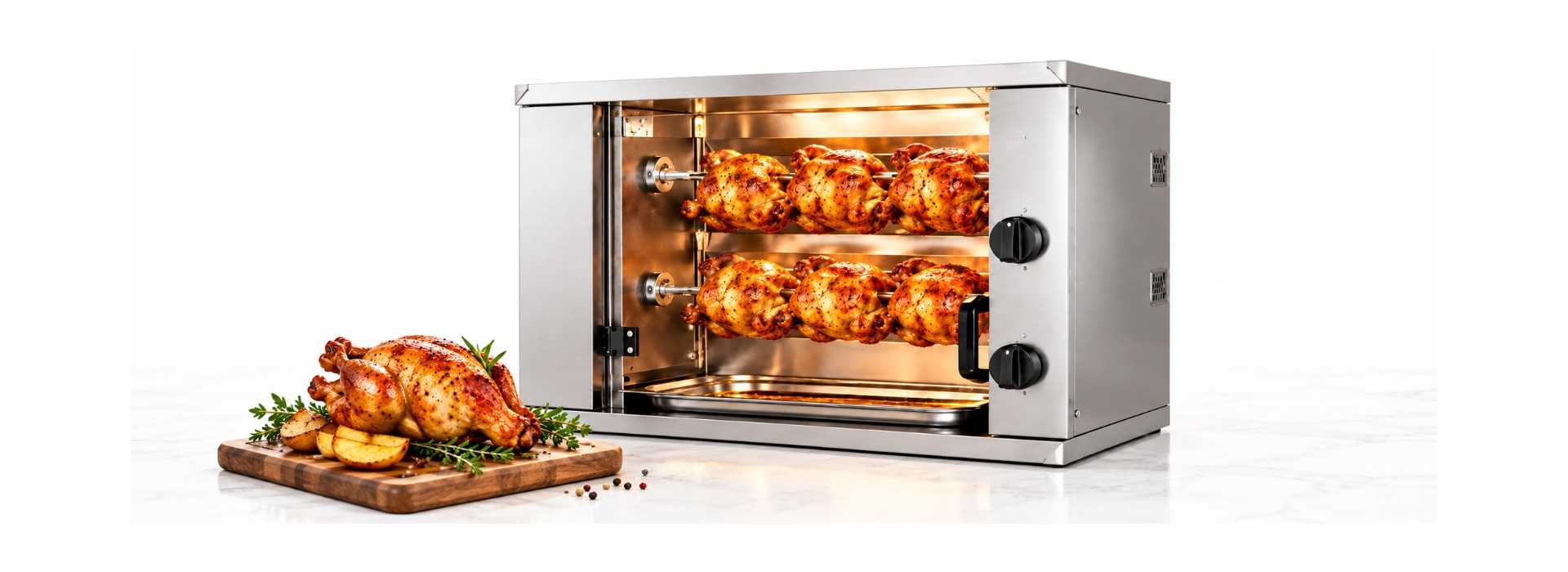
A professional rotisserie is designed to cook food while it rotates on spits in relation to a heat source.
Rotation progressively exposes different areas of the product to heat according to the design of the machine.
Chicken is the product most commonly associated with rotisserie cooking, although actual applications depend on the model, accessories and manufacturer's specifications.
Why is rotation important?
During cooking, rotation continuously changes the position of the product relative to the heat source.
The result also depends on:
- product size;
- weight;
- distance from the heat source;
- temperature;
- cooking time;
- arrangement on the spits;
- machine characteristics.
Professional rotisserie cooking therefore requires a standardised cooking procedure.
Gas or electric rotisserie?
Professional models are available in different configurations.
Gas equipment may suit businesses already organised around a gas installation, while electric models may be more appropriate in other kitchen configurations.
The decision should consider:
- available utilities;
- production volume;
- model specifications;
- space;
- operating requirements;
- intended use.
There is no universally superior option.
How many chickens should it cook?
This is one of the most important purchasing questions.
The largest machine is not automatically the right machine.
A business needs to understand its actual or expected sales volume.
A rotisserie shop selling most of its chickens between 11:30 and 13:30 has different requirements from a supermarket spreading production across a longer period.
Consider:
peak-period sales + cooking-cycle duration + number of production cycles that can be organised.
Actual capacity will also depend on product size and the manufacturer's operating conditions.
Number of spits
The number of spits is an obvious specification, but it should not be considered in isolation.
Also evaluate:
- spit length;
- compatible product size;
- distance between levels;
- rotation system;
- ease of loading and unloading.
The configuration must match the product actually being sold.
A rotisserie can also be a display
Many businesses position the rotisserie directly behind the counter or in another visible area.
This can have a strong merchandising function.
Customers can see:
- the food;
- the cooking process;
- rotation;
- browning;
- available quantity.
The rotisserie can therefore become a cooking display, rather than simply a back-of-house appliance.
Autumn menu opportunities
Roast chicken can be paired with:
🥔 potatoes
🌰 chestnuts
🎃 pumpkin
🍄 mushrooms
🧅 onions
🌿 aromatic herbs
This allows a familiar product to acquire a seasonal identity.
Chef Costantino's related recipe
For this theme, Chef Costantino proposes:
Herb-Roasted Chicken with Potatoes and Chestnuts.
Mediterranean herbs characterise the chicken, while potatoes and chestnuts create a warm autumn accompaniment.
It is easy for customers to understand while still offering scope for more refined preparation and presentation.
Standardising product size
For greater consistency between cooking cycles, products should be as uniform as reasonably possible.
Chickens with substantially different weights may require different management.
Standardisation helps organise:
- loading;
- cooking times;
- cooking controls;
- portioning;
- sales.
This becomes particularly important when several production cycles are completed each day.
Plan cooking cycles around sales
Producing too much too early can be an expensive mistake.
Rotisserie production should be planned around real customer flows.
Useful data include:
- peak sales times;
- average weekday sales;
- weekend sales;
- pre-orders;
- takeaway demand;
- seasonal peaks.
These figures make it easier to organise production cycles.
Production and food waste
High capacity is useful only when there is corresponding demand.
Running a fully loaded machine regardless of sales can create unnecessary surplus.
Production should therefore focus on product turnover, balancing availability during peak demand with waste reduction.
Food safety
External colour alone is not sufficient to determine whether poultry has been safely cooked.
Professional operations must follow their food-safety procedures and required cooking controls.
Safety depends on the entire process, including:
- raw-material storage;
- preparation;
- cooking;
- handling;
- hot holding, where applicable;
- service.
The rotisserie is only one part of this process.
After cooking: hot holding
Once cooking is complete, the next stage must also be managed correctly.
If the product is not served immediately, the business should follow the appropriate procedures for holding and service.
Poor post-cooking management can undermine the quality achieved during cooking.
Cleaning the rotisserie
Chicken and other meats can release substantial quantities of fat and cooking residues.
Cleaning is therefore a central part of daily operation.
Depending on the machine, particular attention may be required for:
- spits;
- internal surfaces;
- glass;
- drip trays;
- supports;
- removable parts.
Always follow the manufacturer's cleaning procedures.
Keep display glass clean
When the rotisserie is customer-facing, glass cleanliness also has a commercial function.
Dirty glass reduces product visibility and can damage the appearance of the counter.
A display machine should communicate cleanliness and professionalism.
Installation and ventilation
Before purchasing, verify the installation requirements for the individual model and applicable regulations.
Relevant factors may include:
- energy supply;
- power;
- ventilation;
- required clearances;
- other installation provisions;
- characteristics of the premises.
Installation should never be improvised.
How to choose a professional rotisserie
Consider:
Real capacity: how much needs to be cooked during peak demand?
Spits: number and configuration must match production.
Energy source: gas or electric according to equipment and available utilities.
Dimensions: measure the installation area carefully.
Visibility: if customer-facing, consider integration with the counter.
Cleaning: evaluate access, removable components and drip trays.
Accessories: verify actual compatibility.
Installation: always check the manufacturer's technical requirements.
Common mistakes
Avoid:
- buying equipment larger than sales require;
- considering only the number of spits;
- failing to check utilities;
- mixing substantially different product sizes without adapting the process;
- judging doneness solely by exterior colour;
- producing too far in advance;
- neglecting post-cooking holding;
- underestimating fat and residue management;
- leaving customer-facing glass dirty;
- failing to plan production around peak demand.
FAQ – Professional Rotisserie Ovens
How does a professional rotisserie work?
Food is mounted on rotating spits and cooked in relation to the machine's heat source.
Are gas and electric rotisseries available?
Yes. Specifications vary between models.
How many chickens can one machine cook?
It depends on capacity, spit configuration, product size and manufacturer specifications.
How should capacity be selected?
Analyse peak sales volume and the number of cooking cycles that can realistically be organised.
Is a customer-facing rotisserie useful?
Where layout and technical requirements permit, showing the product cooking can have a valuable merchandising effect.
Can foods other than chicken be cooked?
This depends on the machine and available accessories. Always check the manufacturer's specifications.
Is exterior colour enough to confirm safe cooking?
No. Appropriate food-safety and cooking-control procedures must be followed.
Conclusion
A professional rotisserie oven can be much more than a cooking appliance.
For rotisserie shops, delicatessens, supermarkets and takeaway businesses, it can become the centre of an entire product category.
The correct choice starts with real numbers: sales volumes, peak demand, production cycles, available space and service style.
Autumn also creates opportunities to develop the classic roast chicken with potatoes, chestnuts, mushrooms, pumpkin and aromatic herbs.
👉 Discover professional rotisserie ovens available from Ristorazione-Refrigerazione and compare solutions for your business.
TAGS
professional rotisserie oven, commercial rotisserie, chicken rotisserie, electric rotisserie, gas rotisserie, roast chicken, rotisserie shop equipment, delicatessen equipment, supermarket rotisserie, takeaway equipment, autumn menu, professional kitchen equipment, HoReCa