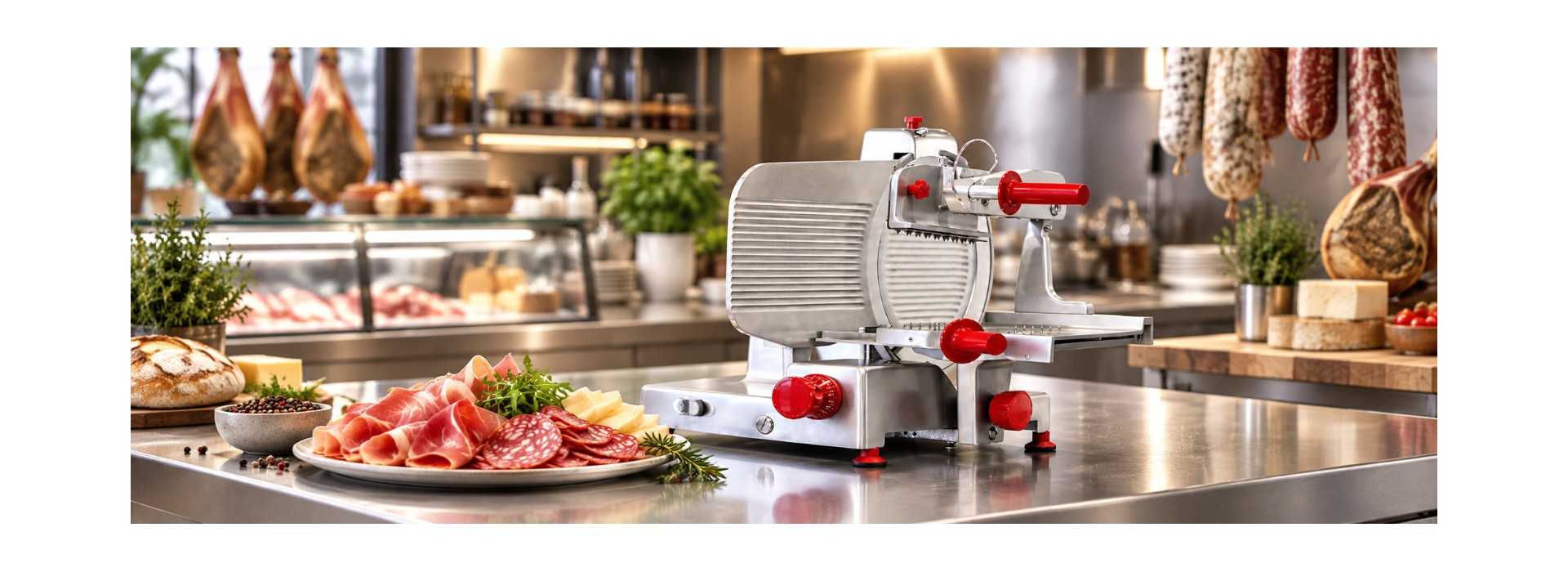
Professional Meat Slicers: Precision, Productivity and Presentation for Charcuterie and Sharing Boards
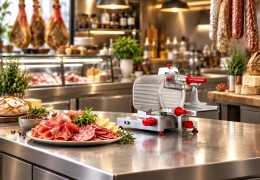
In this context, a professional slicer is not simply a faster way to cut food.
Consistent thickness, portion control, workflow and presentation can all influence the quality of the final service.
What is a professional slicer?
A professional slicer is designed to cut compatible products into slices of adjustable thickness according to the specifications of the machine.
Depending on the model, key components may include:
- blade;
- carriage;
- product tray;
- thickness adjustment;
- product pusher;
- guards;
- sharpening system, where fitted;
- controls and safety devices.
Specifications vary considerably between models.
Why use a professional slicer?
When cured meats are served every day, slicing becomes a genuine production process.
Professional equipment can improve:
- consistency;
- speed;
- repeatability;
- thickness control;
- presentation;
- portion organisation.
These advantages become particularly relevant when products are sliced during service.
Thickness affects the eating experience
The same cured meat can create a different sensory experience depending on slicing thickness.
Thickness can influence:
- mouthfeel;
- texture;
- presentation;
- perceived quantity;
- platter construction.
For this reason, settings should not be completely arbitrary.
Gravity-feed and vertical slicers
Professional equipment is available in different configurations.
A gravity-feed slicer uses an inclined product carriage according to the machine's design.
A vertical slicer uses a different arrangement of the blade and product tray.
Neither solution is universally better.
The correct choice depends on:
- product;
- frequency of use;
- workflow;
- technical specifications;
- operator requirements.
Blade diameter
Blade diameter is one of the most visible technical specifications.
A larger blade does not automatically mean a better machine.
The important factor is whether the equipment can correctly handle the products used by the business.
Always check the manufacturer's actual cutting capacity.
Charcuterie boards
Sharing boards can be offered as:
- appetisers;
- aperitif dishes;
- wine accompaniments;
- tasting selections;
- informal meals.
Consistent slicing can make the final presentation more attractive and easier to standardise.
Autumn charcuterie boards
Seasonal boards can combine:
🥓 selected cured meats
🧀 cheeses
🌰 chestnuts
🍐 pears
🍇 grapes
🍯 honey
🍄 mushroom preserves
🥖 bread and bakery products
This transforms a familiar format into a seasonal menu item.
Chef Costantino's related recipe
For this theme, Chef Costantino proposes:
Gourmet Autumn Charcuterie Board with Cured Meats, Cheeses, Pears, Chestnuts and Honey.
The objective is not simply to fill a board, but to create a tasting sequence.
Savoury cured meats are balanced with cheeses, autumn fruit, chestnuts and honey.
Precise slicing becomes part of the presentation.
Slice to order or prepare in advance?
This depends on the operation and service volume.
Slicing to order can enhance certain products and may create an attractive customer-facing experience.
Higher-volume businesses may require some advance preparation.
Food-safety and storage procedures must always be respected.
Customer-facing slicers
In delicatessens and wine bars, the slicer may be visible to customers.
Cleanliness and organisation therefore have both an hygienic and commercial function.
A poorly maintained machine can negatively affect the perception of the entire counter.
Blade maintenance and safety
The blade must be maintained according to manufacturer instructions.
Where a sharpening system is fitted, it should only be used according to the specified procedure.
Never:
- remove safety guards during operation;
- bypass safety devices;
- place hands near a moving blade;
- use the machine outside its intended purpose;
- clean or maintain the equipment without placing it in the required safe condition.
Cleaning
Cured meats can leave fats and residues on food-contact surfaces.
Cleaning procedures may involve:
- blade;
- tray;
- carriage;
- product pusher;
- guards;
- removable components;
- food-contact surfaces.
Particular care is required around the blade.
Allergens and cross-contact
If different products are processed on the same machine, the cleaning programme should consider:
- allergens;
- cross-contact;
- food characteristics;
- HACCP procedures.
Visible removal of residues alone may not be sufficient for every situation.
Portion control and food cost
Consistent slicing can support portion control.
However, the best approach is still to define standard serving weights and use weighing as appropriate.
The slicer supports consistency; it does not replace a food-cost system.
How to choose a professional slicer
Consider:
Product: what will actually be sliced?
Size: what are the maximum product dimensions?
Frequency: how intensively will the machine be used?
Blade: what diameter and cutting capacity are required?
Configuration: gravity feed, vertical or another suitable design?
Space: how much counter space is available?
Cleaning: how accessible are product-contact areas?
Safety: what guards and systems are fitted?
Common mistakes
Avoid:
- selecting solely by blade diameter;
- buying an unnecessarily large machine;
- failing to check actual cutting capacity;
- using unsuitable products;
- changing thickness without any standard;
- misusing the product pusher;
- removing guards;
- neglecting cleaning;
- handling the blade incorrectly;
- ignoring allergen cross-contact;
- preparing excessive quantities too far in advance.
FAQ – Professional Slicers
What is a professional slicer used for?
It cuts compatible foods into slices of adjustable thickness according to the machine specifications.
Is a gravity-feed or vertical slicer better?
It depends on the products and intended use.
Is a larger blade always better?
No. Blade size should match actual operating requirements.
Can any food be sliced?
No. Always follow the manufacturer's intended-use specifications.
Can a slicer help control food cost?
Consistent slicing can support portion control, but standard serving weights and appropriate weighing remain important.
Is cleaning particularly important?
Yes. Product-contact surfaces and the blade area require careful cleaning according to the manufacturer's procedures.
Conclusion
A professional slicer is a key piece of equipment for restaurants, delicatessens, hotels and wine bars serving cured meats.
The correct model can improve workflow, consistency and presentation.
During autumn, cured meats and cheeses can also become the foundation of seasonal boards featuring pears, grapes, chestnuts, honey and mushroom preserves.
👉 Discover professional slicers available from Ristorazione-Refrigerazione and choose equipment suited to your operation.
TAGS
professional meat slicer, commercial slicer, deli slicer, restaurant slicer, gravity feed slicer, vertical slicer, cured meat slicer, charcuterie board, deli equipment, restaurant equipment, autumn menu, professional kitchen equipment, HoReCa