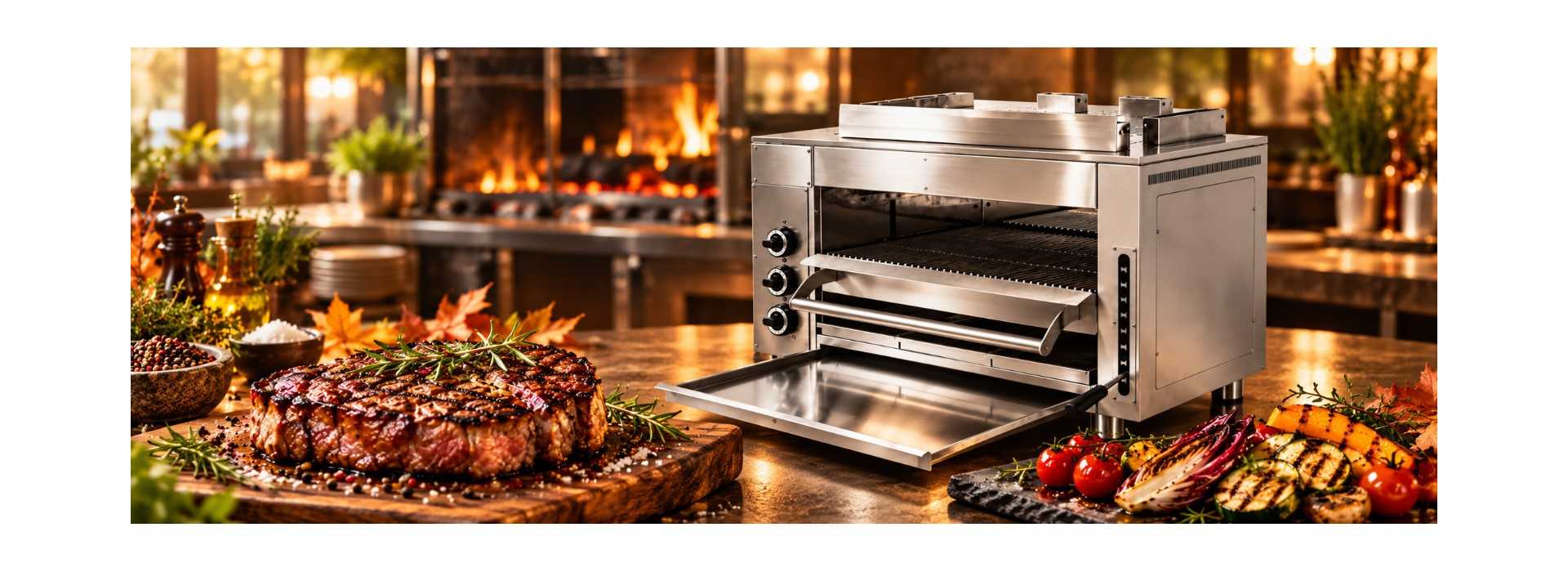
Professional Commercial Grills: Choosing Equipment for Meat, Fish and Vegetables
Autumn also creates new menu opportunities, combining grilled meats with seasonal ingredients such as porcini mushrooms, pumpkin, radicchio and potatoes.
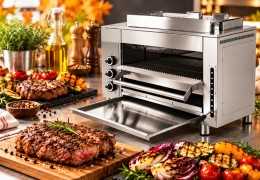
For restaurants, steakhouses, hotels and bistros, choosing a professional commercial grill requires much more than simply selecting the largest cooking surface.
Why is the grill so important?
A grill station can become a complete production line.
During service it may need to manage:
- several orders simultaneously;
- different ingredients;
- different degrees of doneness;
- peak demand;
- cleaning requirements;
- mise en place.
The equipment should therefore be sized according to actual peak grill production.
Gas or electric?
Professional grills are available in different configurations.
Gas grills
These may suit kitchens with the appropriate utility infrastructure.
Evaluate:
- output;
- connection requirements;
- installation;
- ventilation;
- technical specifications.
Electric grills
These may be suitable for other professional kitchen layouts.
Check:
- electrical load;
- voltage;
- available electrical capacity;
- equipment specifications.
Neither energy source is universally superior.
Cooking surface
The available cooking area is a critical factor.
A surface that is too small can become a bottleneck during service.
Oversized equipment, however, can occupy unnecessary space and may not match actual production requirements.
The correct calculation starts with the menu.
Calculate peak load
The important question is not simply:
“How many seats does the restaurant have?”
Instead ask:
“How many grilled portions must the kitchen handle simultaneously at peak demand?”
An 80-seat restaurant selling relatively few grilled dishes may need less capacity than a 50-seat steakhouse where most orders pass through the grill station.
Preheating
The equipment should reach the operating conditions required by the manufacturer and kitchen procedure before production begins.
Loading food too early can affect results.
Preheating should therefore be incorporated into the kitchen's opening routine.
Avoid excessive loading
During peak service it can be tempting to use every available centimetre.
However, the load must remain compatible with the performance of the equipment.
Production should be planned around the grill's effective working capacity.
Grilled meat
Final quality depends on factors including:
- cut;
- thickness;
- initial product temperature;
- meat characteristics;
- cooking surface;
- heat management;
- time;
- resting, where required.
The grill is only one element of the cooking process.
Chef Costantino's related recipe
For this theme, Chef Costantino proposes:
Grilled Entrecôte with Porcini Mushrooms and Herb-Roasted Potatoes.
The beef remains the focal point, accompanied by porcini mushrooms and potatoes to create a warm autumn dish.
The concept is based on a limited number of recognisable ingredients, with emphasis on product quality and accurate cooking.
Vegetables on the grill
Autumn vegetables can expand the grill section beyond meat.
Depending on the preparation and equipment, possibilities include:
🎃 pumpkin
🍄 mushrooms
🥬 radicchio
🧅 onions
🌿 fennel
These can become side dishes or components of vegetarian menu options.
Grilled fish
Fish can also be an important part of the grill station.
Particular attention should be given to:
- delicate handling;
- cooking time;
- cross-contamination;
- allergens;
- cleaning;
- workstation organisation.
When meat and fish share a production area, procedures should be clearly defined.
Raw and cooked food
The workstation must be organised to minimise cross-contamination.
Utensils and containers used for raw products should not be indiscriminately used for cooked food.
Food-safety procedures should be incorporated into the operation's HACCP system.
Cooking control
Exterior appearance alone may not be sufficient to establish food safety.
Where products require specific cooking controls, the appropriate procedures must be followed.
Food type, thickness and preparation method can substantially change cooking requirements.
Grease and residues
Grilling can generate grease and cooking residues.
Depending on the equipment, attention may be required for:
- collection systems;
- trays;
- removable components;
- cooking surfaces;
- cleaning procedures.
Excessive accumulation should not be ignored.
Extraction and ventilation
Professional grilling can generate heat, vapours, grease and other cooking emissions.
The grill station must therefore be considered within the wider kitchen design.
Where applicable, assess:
- extraction;
- ventilation;
- installation requirements;
- clearances;
- power;
- energy supply.
Always follow manufacturer specifications and applicable installation requirements.
How to choose a professional grill
Consider:
Menu: how important is grilled food?
Peak production: how many portions need to cook simultaneously?
Cooking area: is it large enough for the actual workload?
Energy: gas or electric according to the kitchen and model.
Power: is performance appropriate for intended use?
Dimensions: does the machine integrate into the cooking line?
Cleaning: are surfaces and collection systems accessible?
Installation: are technical and ventilation requirements satisfied?
Common mistakes
Avoid:
- choosing solely by physical dimensions;
- undersizing the cooking area;
- buying unnecessary capacity;
- failing to check available power;
- starting production before adequate preheating;
- overloading the grill;
- poorly separating raw and cooked food;
- mismanaging utensils;
- neglecting grease and residues;
- ignoring extraction requirements;
- failing to integrate the grill into the kitchen workflow.
FAQ – Professional Commercial Grills
Is gas or electric better?
It depends on utilities, production requirements and equipment specifications.
How should size be selected?
According to the maximum number of grilled portions that need to be handled simultaneously.
Does the grill need preheating?
It should reach the operating conditions specified for production before cooking begins.
Can meat, fish and vegetables use the same grill?
This depends on the equipment and operating procedures. Cross-contamination and allergen risks must be appropriately managed.
Is extraction required?
Requirements depend on the equipment, installation and applicable regulations and should be checked before installation.
Conclusion
A professional commercial grill can become the centre of an entire section of the menu.
Meat, fish and vegetables require appropriately sized equipment and an efficiently organised workstation.
The key purchasing metric is not simply restaurant capacity, but the number of grilled dishes that must be produced during peak service.
Autumn further expands the possibilities with porcini mushrooms, pumpkin, radicchio, potatoes and other seasonal ingredients.
👉 Discover professional grills available from Ristorazione-Refrigerazione and compare solutions for your kitchen.
TAGS
professional commercial grill, restaurant grill, electric commercial grill, gas commercial grill, grilled steak, grilled entrecote, grilled fish, grilled vegetables, steakhouse equipment, autumn menu, professional cooking equipment, restaurant equipment, commercial kitchen, HoReCa