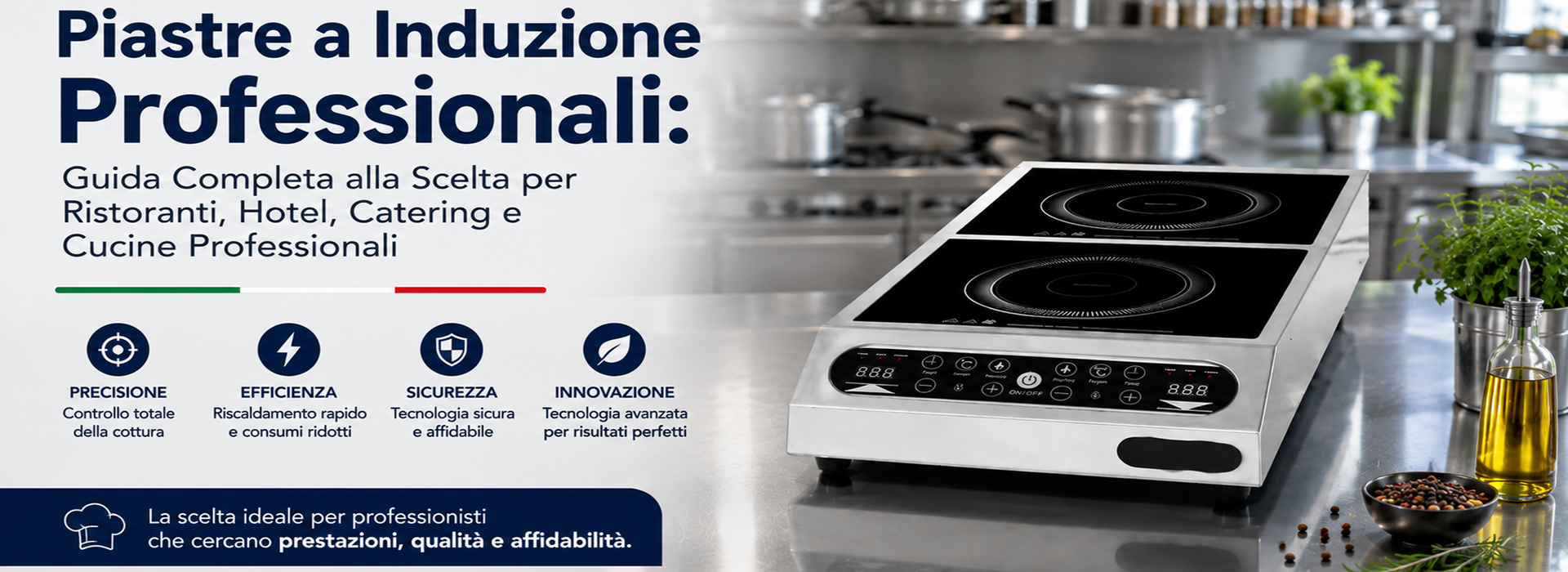
Professional Induction Hobs: Complete Guide for Restaurants, Hotels, Catering and Commercial Kitchens
Professional induction hobs have become one of the most advanced cooking solutions available for commercial kitchens. By generating heat directly inside compatible cookware through electromagnetic technology, they provide exceptional temperature control, rapid heating and outstanding energy efficiency.
Today, restaurants, hotels, catering companies, delicatessens and food production kitchens increasingly rely on induction cooking to improve workflow, reduce energy consumption and maintain consistent cooking quality.
Their combination of speed, safety and precision makes them an excellent choice for both new kitchen installations and existing cooking lines.
How Does a Professional Induction Hob Work?
Unlike traditional gas or electric cooking systems, induction does not generate heat through a flame or heating element.
A powerful electromagnetic coil located beneath the glass ceramic surface creates a magnetic field.
When induction-compatible cookware is placed on the hob, heat is generated directly inside the base of the pan.
This technology offers several important advantages:
- rapid heating;
- instant temperature response;
- minimal heat loss;
- greater energy efficiency;
- improved working comfort.
The result is fast, precise and highly controllable cooking.
Why Choose a Professional Induction Hob?
Professional induction cooking offers numerous operational benefits.
Among the most important are:
- extremely fast heating;
- precise temperature control;
- excellent energy efficiency;
- safer working conditions;
- reduced heat dispersion;
- easy cleaning;
- shorter preparation times;
- consistent cooking performance.
These advantages help professional kitchens increase productivity while maintaining high food quality.
Where Are Professional Induction Hobs Used?
Professional induction hobs are widely used in:
- restaurants;
- hotels;
- resorts;
- delicatessens;
- bistros;
- catering companies;
- institutional kitchens;
- food production laboratories;
- culinary schools;
- demonstration kitchens;
- modern commercial kitchens.
Their flexibility makes them suitable both as primary cooking stations and as support equipment during busy service periods.
Which Preparations Are Ideal?
Professional induction hobs are ideal for:
- meat dishes;
- fish preparation;
- sauces;
- reductions;
- creams;
- risottos;
- soups;
- boiling;
- sautéed vegetables;
- controlled low-temperature cooking;
- food regeneration.
Instant temperature adjustments allow chefs to achieve consistent results even in delicate preparations.
Advantages for Professional Chefs
For chefs, precise temperature control is essential for achieving consistent quality.
Professional induction hobs allow operators to:
- instantly adjust power levels;
- prevent temperature fluctuations;
- reduce the risk of burning food;
- improve cooking consistency;
- standardize recipes;
- work in a safer environment.
These characteristics explain why induction has become one of the preferred cooking technologies in modern professional kitchens.
Types and Configurations
Professional induction hobs are available in a wide range of configurations to suit every commercial kitchen, from small restaurants to high-volume food production facilities.
The most common models include:
- countertop induction hobs;
- built-in induction units;
- single-zone models;
- double-zone models;
- modular induction cooking tops;
- high-power units for intensive production.
Choosing the correct configuration depends on production volume, available workspace and daily cooking requirements.
Construction Materials
Professional induction hobs are built using premium materials designed for intensive commercial use.
Most models feature:
- stainless steel construction;
- heavy-duty glass ceramic cooking surface;
- protected electronic components;
- forced ventilation system;
- digital control panel;
- adjustable non-slip feet on countertop models.
The stainless steel body provides excellent durability and hygiene, while the glass ceramic surface offers outstanding resistance to thermal shock and easy cleaning.
How to Choose the Right Professional Induction Hob
Before purchasing, it is important to evaluate the operational needs of your kitchen.
Key factors include:
- number of meals served daily;
- cooking style;
- required cooking zones;
- available electrical supply;
- cookware dimensions;
- operating frequency;
- ease of cleaning;
- spare parts and technical support.
Selecting the appropriate equipment improves workflow while reducing operating costs.
Cleaning and Maintenance
Proper maintenance helps preserve long-term performance.
After every service it is recommended to:
- allow the cooking surface to cool;
- clean the glass ceramic with suitable products;
- remove all food residues;
- dry the surface thoroughly;
- inspect ventilation openings regularly;
- verify correct operation of the control panel.
Routine maintenance helps maximize equipment lifespan while maintaining consistent performance.
Common Mistakes to Avoid
To achieve the best performance, avoid common operating mistakes such as:
- using cookware that is not induction compatible;
- blocking ventilation openings;
- dragging cookware across the glass ceramic surface;
- using abrasive cleaning products;
- selecting unnecessarily high temperatures;
- neglecting daily cleaning.
Proper operation preserves efficiency and extends the life of the equipment.
Summary Table
| Feature | Benefit |
|---|---|
| Induction heating | Fast and uniform cooking |
| Instant temperature control | Maximum cooking precision |
| High energy efficiency | Lower operating costs |
| Glass ceramic surface | Quick and easy cleaning |
| Stainless steel body | Durability and hygiene |
| Minimal heat dispersion | More comfortable kitchen environment |
| High operational safety | Reduced burn risk |
| Professional performance | Ideal for intensive daily use |
Frequently Asked Questions
Which cookware can be used on a professional induction hob?
Professional induction hobs require cookware with a ferromagnetic base. Stainless steel magnetic cookware and cast iron are generally compatible, while aluminum, copper and glass cookware can only be used if specifically designed for induction cooking.
Do professional induction hobs reduce energy consumption?
Yes. Because heat is generated directly inside the cookware, professional induction hobs achieve very high energy efficiency while significantly reducing heat loss compared to traditional gas or electric cooking systems.
Are professional induction hobs suitable for intensive commercial use?
Absolutely. Commercial induction hobs are engineered to operate continuously throughout demanding service periods while maintaining consistent cooking performance and reliability.
Can temperature be adjusted accurately?
Yes. One of the greatest advantages of induction cooking is its immediate response to power adjustments, allowing chefs to control temperature with exceptional precision during every stage of cooking.
Does the cooking surface become extremely hot?
The glass ceramic surface is heated mainly by contact with the hot cookware. Once cooking is finished, it cools down relatively quickly, providing a safer working environment than many traditional cooking systems.
Is cleaning difficult?
No. The smooth glass ceramic surface is extremely easy to clean. In most cases, a suitable cleaner and a soft cloth are sufficient to remove food residues after service.
Does induction equipment require special maintenance?
Maintenance requirements are minimal. Operators should regularly clean the cooking surface, keep ventilation openings free from dust and grease, and follow the maintenance recommendations provided by the manufacturer.
What are the main advantages compared to traditional cooking systems?
Professional induction hobs allow kitchens to:
- reduce heating time;
- improve cooking precision;
- increase energy efficiency;
- minimize heat dispersion;
- create a more comfortable working environment;
- simplify cleaning;
- improve operator safety.
Conclusion
Professional induction hobs represent one of the most advanced cooking technologies available for commercial kitchens.
Their rapid heating, outstanding temperature control, high energy efficiency and easy maintenance make them an excellent solution for restaurants, hotels, catering companies, delicatessens, institutional kitchens and food production laboratories seeking greater productivity and consistently high cooking quality.
Before purchasing, businesses should carefully evaluate the number of cooking zones required, the available electrical supply, cookware compatibility and the available workspace. Selecting the right model ensures long-term reliability while integrating perfectly into the daily workflow of the kitchen.
Investing in a professional induction hob means choosing a modern, efficient and dependable cooking solution capable of delivering outstanding results every day.
Related Category
To complete your cooking line, explore our range of Professional Gas Cooktops, ideal for chefs who require high heat output, exceptional versatility and reliable performance for traditional cooking techniques.
Chef Costantino Recipe
Orange and Ginger Salmon Fillet with Crunchy Vegetables perfectly demonstrates how a professional induction hob delivers precise temperature control, producing crispy salmon skin while keeping the flesh tender, juicy and full of flavor. Instant heat adjustment helps maintain consistent results even during busy service periods.
Call to Action
Looking for a professional induction hob for your commercial kitchen?
At Ristorazione-Refrigerazione, you'll find a carefully selected range of professional induction cooking solutions designed for restaurants, hotels, catering companies, food production laboratories and commercial kitchens.
Our specialists are ready to help you choose the ideal model to improve efficiency, precision and productivity in your kitchen.