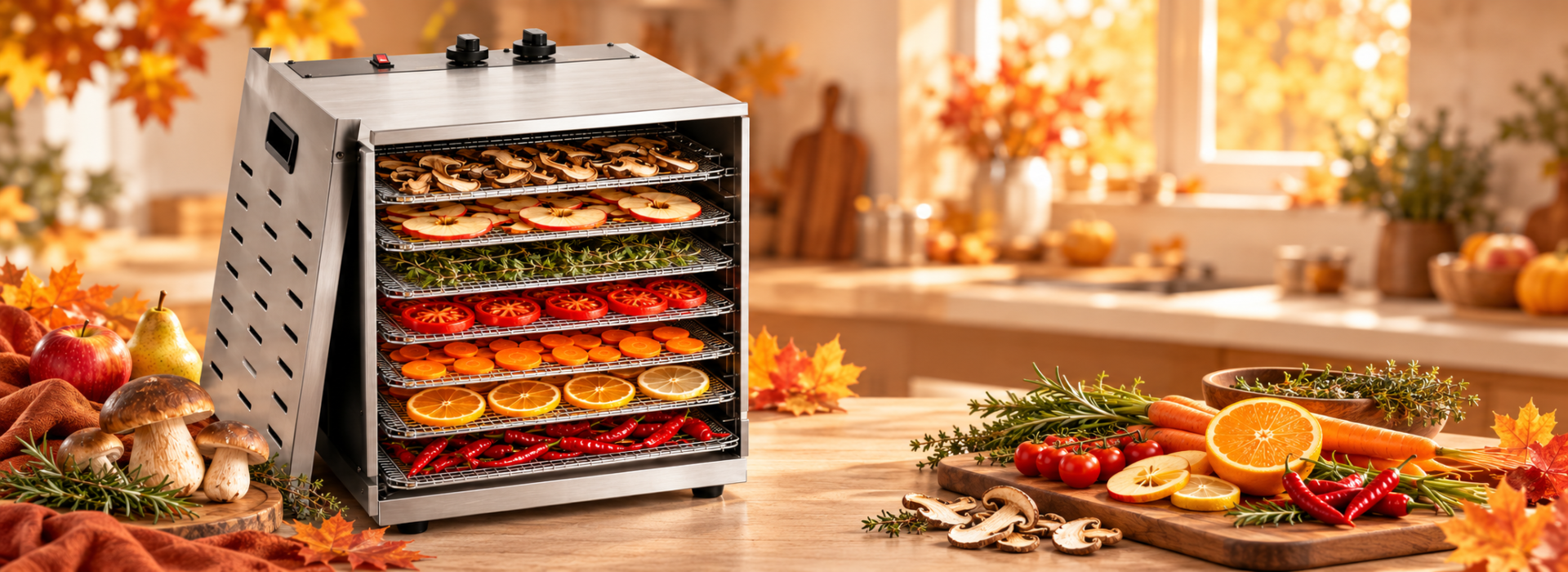
Professional Food Dehydrators: How to Make the Most of Autumn Mushrooms, Fruit, Vegetables and Herbs
Dehydration can transform their characteristics by reducing moisture under controlled conditions, opening up new possibilities in both kitchen organisation and culinary creativity.
This is precisely the time of year when a professional food dehydrator can become a particularly useful piece of kitchen equipment.
What is a professional food dehydrator?
A professional food dehydrator is equipment designed to progressively reduce the moisture contained in food through the management of temperature, airflow and time.
Air circulates around the food placed on trays, promoting the evaporation of water.
The final result depends on several factors:
- type of food;
- initial moisture content;
- size and thickness;
- arrangement on the trays;
- temperature;
- airflow;
- processing time;
- characteristics of the equipment.
There is therefore no single programme suitable for every ingredient.
Why use a dehydrator in a restaurant?
Dehydration is often associated exclusively with preservation.
In a contemporary professional kitchen, however, it can play a much broader role.
A dehydrated product can become a new culinary ingredient.
A mushroom can be transformed into an aromatic powder. A slice of apple can become a crisp garnish for a dessert. Aromatic herbs can be incorporated into customised seasoning blends.
The dehydrator therefore becomes a tool for working with flavour, texture and presentation.
Mushrooms: an autumn favourite
Mushrooms are one of the ingredients most closely associated with autumn cuisine.
Porcini, in particular, are widely used in risotto, fresh pasta, meat dishes and sauces.
Dehydration creates a product with characteristics very different from the fresh ingredient.
Once properly dried, mushrooms can be used according to the intended preparation or ground to produce an aromatic mushroom powder.
It can be used with:
- risotto;
- fresh pasta;
- sauces;
- stocks and reductions;
- meat preparations;
- finishing elements.
From dried porcini to culinary powder
One of the most interesting contemporary applications is turning dehydrated ingredients into powders.
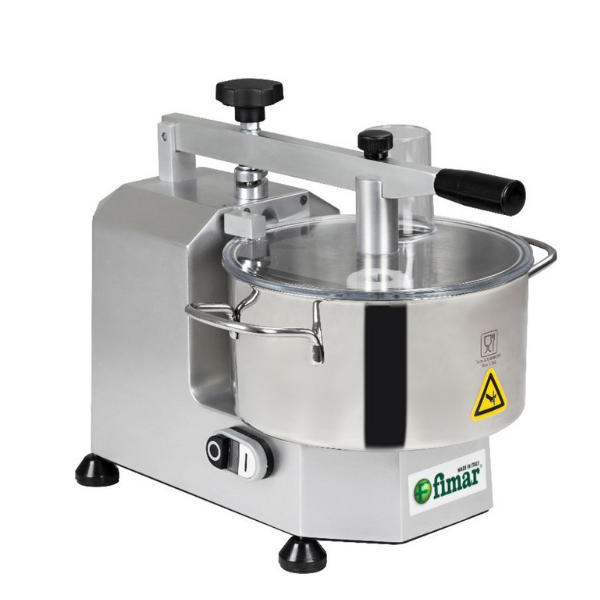
Once the desired dehydration result has been achieved, the mushroom can be processed with suitable equipment until a very fine texture is obtained.
The powder can then be sieved and used in small quantities.
The culinary advantage is clear: rather than adding volume to the dish, the chef can introduce aroma and character with a relatively small amount of ingredient.
Chef Costantino's related recipe
For this autumn theme, we have selected:
Carnaroli Risotto with Porcini Mushrooms, Dried Mushroom Powder and Parmigiano Reggiano.
Porcini are used in two forms: fresh, to provide texture, and dehydrated, to produce an aromatic finishing powder.
It is a practical example of how professional equipment can be connected directly to culinary creativity.
Dehydrating autumn fruit
Autumn also brings apples and pears, two highly versatile ingredients for professional kitchens.
Before dehydration, it is important to produce pieces that are as uniform as possible.
Thickness influences both processing time and consistency.
Once processed, dried fruit can be used for:
- hotel breakfast buffets;
- pastry;
- plated desserts;
- snacks;
- garnishes;
- accompaniments to cheese and savoury preparations.
A thin dehydrated apple slice, for example, can become a crisp component of an autumn dessert.
Aromatic herbs
Rosemary, sage, thyme and many other aromatic herbs are extensively used in professional cooking.
Dehydration can transform them into ingredients for later use in seasoning blends, preparations and aromatic mixtures.
Parameters should always be appropriate to the ingredient and desired result.
Vegetables
Professional dehydrators can also be used with many vegetables.
Tomatoes, peppers, courgettes, chillies and other suitable products can develop very different characteristics once moisture has been reduced.
They can become:
- crisps;
- powders;
- garnishes;
- sauce components;
- seasoning ingredients;
- aromatic elements.
Why uniform cutting matters
Food preparation is an important part of the process.
Pieces with substantially different thicknesses may respond differently during the same cycle.
Whenever possible, it is therefore useful to create a regular cut.
Standardisation is particularly important in professional kitchens, where results should be reproducible.
Avoid overloading the trays
Air needs to circulate properly around the product.
Overfilling trays or excessively overlapping ingredients can obstruct airflow and affect the uniformity of the process.
The nominal capacity of the machine should therefore be considered together with the actual usable processing surface.
How to choose a professional dehydrator
There is no single ideal model for every business.
Several factors should be considered before purchasing.
1. Production volume
How much product needs to be processed during each cycle?
A small restaurant will have different requirements from a food-production laboratory.
2. Number and size of trays
The number of levels and available surface area directly affect processing capacity.
3. Temperature control
Appropriate temperature control makes it possible to adapt the process to different ingredients and preparations.
4. Airflow
Air distribution inside the chamber is important for promoting uniform processing.
5. Construction
Professional operators should evaluate robustness, construction characteristics and ease of cleaning.
6. Dimensions
Equipment should be selected according to both production requirements and the actual space available.
7. Cleaning
Trays and processing areas should be manageable according to the manufacturer's cleaning instructions.
How much electricity does a professional dehydrator use?
Rated power alone does not determine actual consumption.
Operating time and frequency must also be considered.
A basic assessment therefore considers:
equipment power × operating hours × frequency of use.
The quantity of food processed per cycle should also be taken into account when assessing overall efficiency.
Dehydration and food safety
An important point: dehydrating food does not automatically make it safe or suitable for indefinite storage.
The final result depends on the ingredient, process, residual moisture, handling, packaging and subsequent storage conditions.
In a professional operation, dehydration should therefore be integrated into the appropriate food-safety and HACCP procedures.
Common mistakes to avoid
Typical mistakes include:
- processing pieces with very different dimensions;
- excessive overlapping;
- overloading trays;
- using unsuitable parameters;
- stopping the process before the required result is achieved;
- neglecting cleaning;
- storing the product without considering its final condition;
- applying exactly the same process to very different foods.
The dehydrator as a creative kitchen tool
This is perhaps its most interesting application for restaurants.
A dehydrator does not have to be considered simply a preservation machine.
It can become a tool through which chefs transform ingredients.
For example:
fresh porcini → dried porcini → porcini powder
or:
fresh apple → thin slice → crisp garnish
or:
tomato → dehydration → powder or aromatic component.
These transformations expand the culinary possibilities of the same raw ingredient.
FAQ – Professional Food Dehydrators
What foods can be processed in a professional dehydrator?
It depends on the equipment and intended process. Mushrooms, fruit, vegetables and aromatic herbs are among the most common applications.
Can porcini mushrooms be dehydrated?
Suitable edible mushrooms can be processed using appropriate dehydration procedures.
Can dried porcini be turned into powder?
Once properly dehydrated, they can be finely ground and used as an aromatic ingredient.
Can apples and pears be dehydrated?
Yes, using preparation methods and parameters appropriate to the product and desired result.
How long does dehydration take?
There is no universal duration. It depends on the ingredient, thickness, moisture content, load, settings and equipment.
Does every food use the same temperature?
No. Different products require different processing conditions.
How should I choose dehydrator capacity?
Consider processing volume, frequency of use, number of trays, usable surface area and available kitchen space.
Does dehydration mean every food can then be stored without refrigeration?
No. Subsequent storage requirements depend on the product and process. Appropriate food-safety procedures must always be followed.
Conclusion
Autumn provides professional kitchens with an exceptional variety of ingredients.
A professional food dehydrator offers another way to work with them: not only through preservation, but through ingredient transformation.
Mushrooms, fruit, vegetables and herbs can become powders, crisp garnishes, seasonings and components for new culinary preparations.
👉 Discover professional food dehydrators on Ristorazione-Refrigerazione and compare the solutions available for your business.
TAGS
professional food dehydrators, food dehydrator, food dehydration, commercial dehydrator, dried mushrooms, dried porcini, dried fruit, dried vegetables, aromatic herbs, autumn cuisine, professional kitchen, restaurant equipment, HoReCa