Professional Blast Chillers: Food Safety, Organisation and Quality in Commercial Kitchens
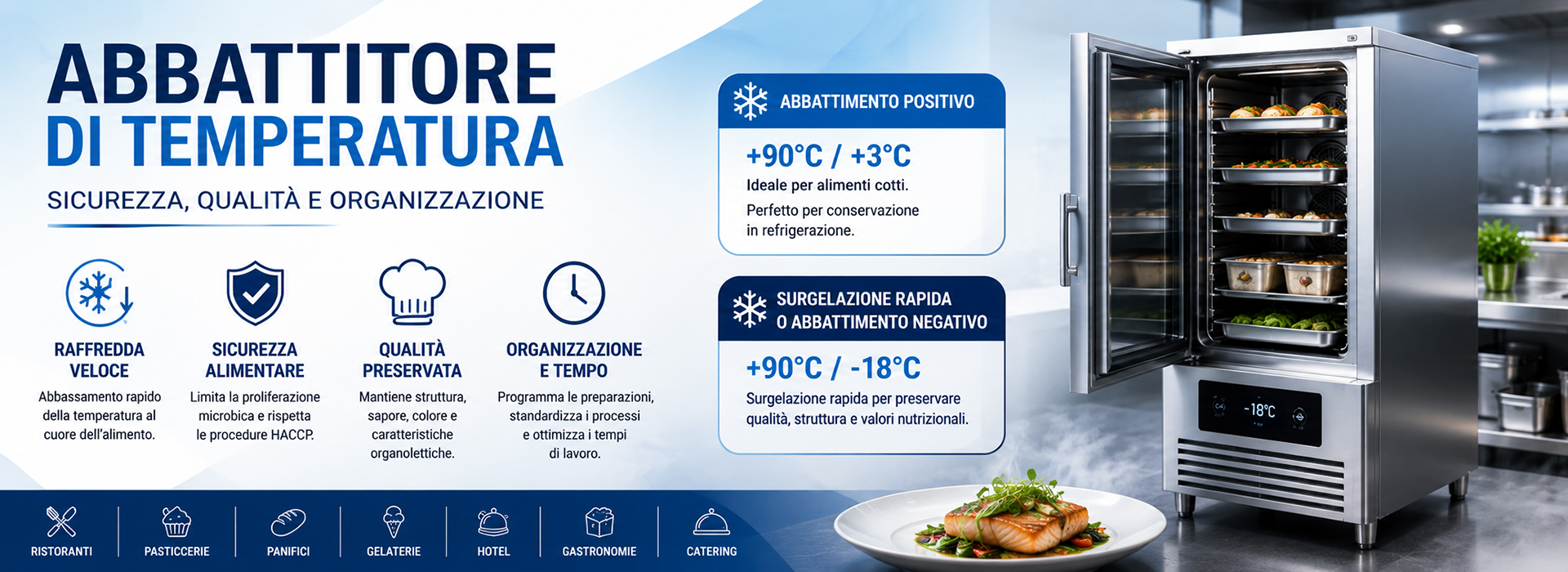
Ablast chiller is one of the most important appliances for organising production correctly in a commercial kitchen. Its purpose is not simply to cool food, but to reduce its temperature rapidly through controlled cycles, limiting microbial growth and helping preserve texture, flavour, colour and organoleptic qualities.
Restaurants, pastry shops, bakeries, gelato shops, hotels, delicatessens, food laboratories and catering services can use blast chillers to schedule preparation, standardise processes and manage the transition from cooking to storage more safely.
To select the most suitable model, operators must evaluate capacity, refrigeration power, tray configuration, available cycles, compatibility with existing containers and the actual production volume of the business.
What Is a Blast Chiller?
A blast chiller is a professional appliance designed to remove heat from food much faster than a conventional refrigerator or freezer.
A refrigerator maintains products that are already cold, but it is not designed to receive large quantities of hot food. Placing freshly cooked preparations inside can increase the temperature of the compartment, slow down the cooling process and compromise the storage of the other products.
A blast chiller uses high-speed cold air to reduce the temperature at the core of the food rapidly. The cycle is controlled through time, temperature and, on equipped models, a probe inserted into the product.
The two main processes are:
-
positive blast chilling;
-
rapid freezing or negative blast chilling.
Operating temperatures and times must be managed according to the appliance manual, the type of food and the procedures established in the business’s HACCP plan.
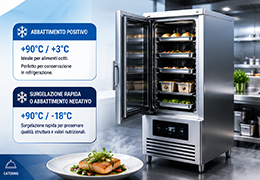
Positive Blast Chilling
Positive blast chilling is used to bring cooked food rapidly to a temperature suitable for subsequent refrigerated storage.
It can be applied to numerous preparations, including:
-
pasta and rice dishes;
-
cooked meat;
-
fish;
-
vegetables;
-
sauces and stocks;
-
creams;
-
baked products;
-
fillings;
-
prepared foods;
-
pastry bases.
Rapidly passing through the temperature range that is most favourable to microbial growth contributes to a safer process. Once the cycle has been completed, the food must immediately be transferred to a suitable refrigerated-storage system.
A blast chiller does not replace a refrigerator. It completes the production process by preparing the product for correct storage.
Rapid Freezing or Negative Blast Chilling
Rapid freezing brings food to a negative core temperature within a reduced period.
Compared with slow freezing, this process promotes the formation of smaller ice microcrystals. Smaller crystals cause less damage to the cellular structure of food, helping limit the loss of liquids during defrosting.
This benefit is particularly evident when processing:
-
meat;
-
fish;
-
fresh pasta;
-
bread and leavened products;
-
pastry products;
-
semifreddos;
-
individual desserts;
-
prepared bases;
-
portioned ready-made dishes.
The final quality still depends on the raw materials, packaging, correct arrangement of the products and maintenance of the entire cold chain.
Why a Refrigerator Cannot Replace a Blast Chiller
A commercial refrigerator is designed primarily to maintain a stable temperature. When very hot food is placed inside, the compressor must manage a high thermal load and the internal temperature can rise significantly.
This can cause:
-
excessively slow product cooling;
-
an increase in the temperature of food already being stored;
-
greater condensation;
-
increased energy consumption;
-
possible food-safety problems;
-
loss of texture and quality.
A blast chiller has the refrigeration power, ventilation and control systems specifically developed to remove heat from food rapidly.
For this reason, the capacity of a blast chiller should not be compared directly with the volume of a refrigerator. An apparently compact appliance may require considerable power to complete its cycles within the specified parameters.
Better Production Organisation
One of the main advantages of a blast chiller is the ability to separate preparation time from service time.
More complex work can be scheduled during quieter periods, correctly blast chilled, labelled and stored. During service, the kitchen team can then concentrate on regeneration, finishing and plating.
This system makes it possible to:
-
distribute the workload more effectively;
-
reduce pressure during peak hours;
-
standardise portions;
-
limit delays and improvisation;
-
organise advance production;
-
control stock more accurately;
-
reduce waste;
-
achieve more consistent results.
Advance preparation must always be supported by precise procedures covering cooling, storage, labelling, shelf life, regeneration and traceability.
Protecting Organoleptic Quality
Slow cooling continues to alter food even after cooking has ended.
Residual heat can prolong the cooking process, soften some structures excessively, alter the colour of vegetables and increase moisture loss. Creams, sauces and delicate preparations may also develop a less uniform consistency.
Rapid blast chilling interrupts this thermal development more quickly and helps preserve:
-
texture;
-
juiciness;
-
colour;
-
aroma;
-
flavour;
-
moisture;
-
portion consistency.
The result does not depend exclusively on the machine. Suitable containers must be used, the indicated quantities must be respected and sufficient space must be left for air circulation.
Timed Cycles and Core-Probe Cycles
Many blast chillers allow operators to select either timed operation or control through a core probe.
During a timed cycle, the machine operates for a preset period. This method can be used for standardised production, but the quantity, thickness, initial temperature and arrangement of the food must remain consistent.
A probe-controlled cycle measures the temperature directly at the core of the product. The probe must be inserted correctly into the section that cools most slowly, avoiding bones, cavities or other areas that could produce an unrepresentative reading.
For products with different dimensions and compositions, core-temperature control provides a more precise indication of the cycle’s progress.
The probe must be cleaned and sanitised before and after every use, in accordance with the business’s procedures.
Soft and Hard Cycles
Some models provide soft and hard programmes.
A soft cycle applies a more gradual cooling action. It is suitable for delicate or thin products that could be damaged by excessively low air temperatures.
A hard cycle uses greater refrigeration intensity and is appropriate for dense, thick or high-thermal-load products.
The programme should not be selected solely according to the desired speed. An excessively aggressive cycle can overcool the surface, while an insufficient cycle may fail to achieve the required result within the expected time.
Operators should therefore follow the manufacturer’s instructions and validate the programmes used for recurring preparations.
Capacity Expressed in Kilograms
Blast-chiller capacity is generally indicated by the number of trays and the kilograms of product that can be processed during each cycle.
The number of trays describes the available space, while capacity in kilograms indicates the quantity that the machine can process under the conditions specified by the manufacturer.
These two values should not be confused. Filling every level with heavy or deep containers can create a thermal load that exceeds the appliance’s actual capacity.
To identify the correct model, consider:
-
the maximum quantity produced in a single session;
-
the initial temperature of the food;
-
the weight placed on each tray;
-
product thickness;
-
frequency of the cycles;
-
need for positive chilling or negative freezing;
-
seasonal production peaks.
An undersized blast chiller forces the kitchen to divide production into too many batches and can slow down the entire process. An excessively large model may involve purchase costs and energy consumption that are disproportionate to the business’s needs.
Compatibility with Trays and Containers
Before purchasing a blast chiller, it is essential to verify the format of the supports accepted by the machine.
Blast chillers may be designed for:
-
GN trays;
-
EN pastry trays;
-
Gastronorm containers;
-
grids;
-
specific formats indicated by the manufacturer.
Compatibility should be evaluated in relation to the ovens, refrigerated cabinets, trolleys and preparation tables already used in the kitchen or laboratory.
Using the same format makes it possible to transfer trays from one stage to another without moving the food into different containers, reducing handling, preparation time and contamination risks.
Containers should not be excessively deep when the product requires uniform cooling. Thinner, evenly distributed portions support more effective heat exchange.
Correct Product Arrangement
Cold air must be able to reach all surfaces.
Trays should not be overloaded, and food should not be arranged in excessively thick layers. Products should not be covered in a way that obstructs cooling unless this is specifically required by the operating procedure.
To obtain repeatable cycles, it is advisable to standardise:
-
weight per tray;
-
depth of the product;
-
portion dimensions;
-
initial temperature;
-
probe position;
-
selected programme;
-
subsequent packaging method.
These details can be included in the kitchen’s operating sheets and verified periodically.
Labelling and Traceability
After blast chilling, every preparation must be identified clearly.
Depending on the business’s procedures, the label may include:
-
product name;
-
preparation date;
-
chilling date and time;
-
responsible operator;
-
quantity;
-
batch number;
-
final temperature;
-
use-by date;
-
storage conditions;
-
allergens.
Blast chilling does not automatically make food safe for an unlimited period. Shelf life must be established according to the recipe, processing method, packaging, storage conditions and HACCP plan.
Blast Chilling and Food-Waste Reduction
Planned production allows raw materials and semi-finished products to be processed in quantities that are consistent with expected sales.
Preparations can be portioned, blast chilled and stored according to established procedures. This helps prevent large quantities of food from remaining unused at the end of service.
A blast chiller can contribute to waste reduction through:
-
improved management of planned surplus production;
-
uniform portioning;
-
better stock control;
-
more organised storage;
-
regeneration of only the quantity required;
-
reduced loss of quality.
It must not be used to recover food that has already been handled incorrectly. Only suitable products processed and stored in accordance with the required procedures should be placed in the machine.
Use in Pastry and Bakery Production
In pastry laboratories, a blast chiller can rapidly stabilise creams, mousses, glazes, inserts, semifreddos and individual desserts.
Rapid freezing can also facilitate:
-
removal from moulds;
-
cake assembly;
-
glazing;
-
storage of prepared bases;
-
production planning;
-
advance preparation of individual desserts.
In bakeries, it can be used to manage baked products, bases, doughs and other preparations compatible with the available cycles. Programmes and operating methods must be selected according to the desired result and the characteristics of the appliance.
Use in Restaurants and Catering
In restaurants, a blast chiller can be integrated into numerous processes, including the preparation of stocks, sauces, roasts, fresh pasta, ready-made dishes, cooked vegetables and desserts.
In catering operations, it becomes particularly important because it supports advance production, correct storage and organised transportation. The cold chain must be maintained throughout every phase, from the production laboratory to the event location.
Regeneration must be performed with suitable equipment and programmes, with careful control of time and temperature. Food that has been correctly blast chilled can still lose safety and quality if it is subsequently transported, stored or regenerated incorrectly.
Cleaning and Maintenance
The internal chamber should be cleaned after every use according to the manufacturer’s instructions.
The cleaning procedure should include:
-
internal walls;
-
tray runners;
-
door seals;
-
drains;
-
core probe;
-
handle;
-
external surfaces;
-
areas where condensation may accumulate.
Before cleaning, the appliance must be placed in the safe condition indicated in its manual. Aggressive detergents, abrasive tools and unauthorised water jets must not be used.
Door seals should be inspected regularly because an improper seal increases heat exchange with the surrounding environment and reduces efficiency.
It is also advisable to check the cleanliness of the condenser, ventilation, correct probe operation and the absence of active alarms.
Installation and Technical Clearance
A blast chiller releases heat during operation and must be installed in a suitably ventilated environment.
Before purchase, verify:
-
external dimensions;
-
space required to open the door;
-
technical clearances;
-
electrical supply;
-
power consumption;
-
room temperature;
-
drainage system, when required;
-
access for servicing and maintenance.
An excessively high ambient temperature or insufficient ventilation can reduce performance and increase energy consumption.
Installation must be carried out by qualified personnel in accordance with the manufacturer’s technical instructions.
How to Select a Professional Blast Chiller
The selection process should begin with the actual production requirements of the business.
The main factors to evaluate are:
-
kilograms processed during each cycle;
-
number and format of trays;
-
positive chilling and negative freezing functions;
-
availability of a core probe;
-
soft and hard programmes;
-
external dimensions and available space;
-
electrical supply and power requirements;
-
compatibility with existing equipment;
-
ease of cleaning;
-
availability of technical assistance and spare parts.
The expected growth of the business should also be considered. A laboratory whose production is increasing rapidly may soon require more capacity than its initial workload suggests.
Related Category on Ristorazione-Refrigerazione
Explore the selection of professional blast chillers available from Ristorazione-Refrigerazione to compare capacities, dimensions, configurations and technical characteristics for restaurants, pastry shops, bakeries, gelato shops, delicatessens and food-production laboratories.
Related Chef Costantino Recipe
Pistachio Semifreddo with White Chocolate and Raspberry
This professional preparation uses rapid freezing to stabilise the structure of the semifreddo, facilitate removal from the mould and organise advance production of individual portions.
The complete recipe will be published on Chef Costantino with quantities per portion, total ingredients, professional procedure, Critical Control Points, plating instructions and food-cost calculation.
Conclusion
A blast chiller is an essential tool for combining food safety, product quality and production organisation.
The appliance must be selected according to the actual quantity of food processed, the tray formats used and the cycles required. Its full value becomes clear when it is integrated into a standardised process covering cooking, blast chilling, labelling, storage and regeneration.
To identify the most appropriate blast chiller for your business, explore the dedicated selection or contact Ristorazione-Refrigerazione for support in evaluating the model, capacity and technical characteristics required.