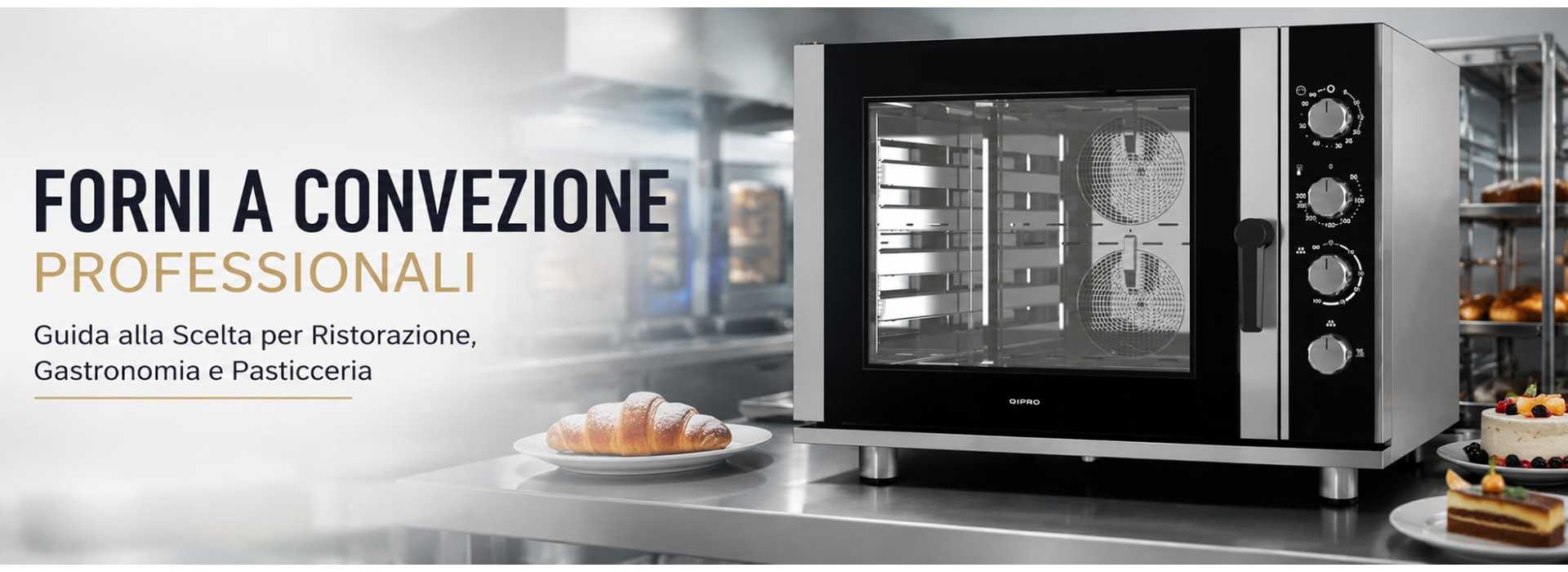
Professional Convection Ovens: A Guide to Choosing the Right Model for Restaurants, Catering and Pastry Production
Professional convection ovens are essential appliances in restaurant kitchens, hotels, catering businesses, canteens, bakeries and pastry laboratories. By circulating hot air throughout the cooking chamber, they distribute heat evenly and provide consistent cooking results across multiple levels.
Choosing the right oven should not be based solely on price or external dimensions. Capacity, power supply, control system, steam functions and tray format all have a direct impact on workflow, productivity and the quality of the finished dishes.
How a professional convection oven works
In a convection oven, one or more fans circulate hot air throughout the cooking chamber. This continuous airflow provides more even heat distribution than static cooking and makes it possible to use several cooking levels simultaneously.
This system can help:
-
achieve more uniform browning;
-
reduce differences in cooking between trays;
-
speed up many preparations;
-
improve consistency;
-
organise repeated production more efficiently.
In models equipped with reversing fans, the airflow is distributed more evenly, reducing temperature differences within the cooking chamber.
Convection oven or combination steam oven
A convection oven mainly uses ventilated hot air and is suitable for roasting, gratinating, baking and completing a wide range of foodservice preparations.
Combination models add controlled steam to convection cooking. This function increases the oven’s versatility and makes it possible to prepare foods that require a more humid cooking environment.
Steam can be useful for:
-
limiting excessive moisture loss;
-
retaining tenderness inside the food;
-
supporting the development of certain bakery products;
-
regenerating previously prepared dishes;
-
cooking vegetables, meat, fish and catering products;
-
producing a browned surface while preserving internal moisture.
The choice depends on the menu and the preparations carried out every day. A standard convection model may be sufficient for predominantly dry cooking, while a kitchen producing a diverse range of dishes may benefit more from a combination oven with steam.
Electric or gas oven
Professional convection ovens can be powered by electricity or gas.
Electric ovens
Electric models are widely used because of their straightforward installation and precise temperature adjustment. Before purchasing, it is essential to check the oven’s power consumption and ensure that the premises have a suitable electrical system.
Compact ovens may be available with a single-phase power supply, while larger and more powerful models frequently require a three-phase connection.
Gas ovens
Gas ovens are often selected for kitchens with high production volumes or premises that already have a suitable gas system. Installation must be carried out by qualified personnel and comply with the technical requirements applicable to professional kitchens.
To compare the two solutions correctly, it is important to consider the available power, frequency of use, energy costs, existing utility connections and required production capacity.
Capacity and tray format
Oven capacity should be selected according to the average number of covers, the quantity of food produced and the frequency of cooking cycles.
Compact models with three or four trays can be suitable for cafés, bistros, small laboratories and businesses with limited production. Six-, seven- or ten-tray ovens can meet the requirements of restaurants, catering businesses, hotels and pastry laboratories with heavier workloads. Larger-capacity ovens and trolley models are also available for intensive production.
The most common formats include:
-
GN 1/1, primarily used in restaurants and professional catering;
-
600×400 mm, commonly used in bakeries and pastry production;
-
models compatible with both formats, offering greater flexibility to businesses with different types of production.
The distance between tray guides should also be checked. Wider spacing allows taller products to be inserted, while narrower spacing can increase the number of trays used during the same cycle.
Mechanical, digital or touchscreen controls
The control system determines the oven’s level of precision and automation.
Mechanical controls
Mechanical controls are simple and immediate. They allow the operator to manually adjust temperature, cooking time and, on compatible models, the amount of steam. They are suitable for standard cooking processes and for businesses that prefer straightforward operation.
Digital controls
Digital controls provide more precise adjustments and may include programmable recipes, multiple cooking stages, core temperature management and customised settings.
Touchscreen controls
Touchscreen models are designed for more advanced operation. They can allow users to create and save recipes, manage different cooking parameters and standardise production even when the oven is used by different members of staff.
Programmability is particularly useful for businesses that regularly prepare the same dishes and need to maintain consistent results.
How to choose a professional convection oven
Before purchasing an oven, several important factors should be evaluated:
-
type of dishes and products to be prepared;
-
average number of covers or production quantity;
-
format of the trays already in use;
-
required capacity;
-
availability of single-phase, three-phase or gas connections;
-
absorbed power;
-
steam function;
-
control system;
-
connection for a core probe;
-
external dimensions and available space;
-
door opening direction;
-
ease of cleaning;
-
automatic washing system, when required;
-
need for stands, extraction hoods or additional accessories.
The oven with the largest capacity is not always the best choice. An oversized appliance may require unnecessary space and energy, while an oven that is too small can slow down service and require an excessive number of cooking cycles.
Applications in professional kitchens and laboratories
A convection oven can be used to prepare roasts, vegetables, gratins, lasagne, catering products, fish, meat dishes, biscuits, tarts, leavened products and many pastry bases.
In combination models, the addition of steam further expands the available cooking techniques and provides greater control during cooking, regeneration and the preservation of the product’s characteristics.
This versatility makes convection ovens suitable for both kitchens with extensive menus and laboratories specialising in a particular type of production.
Cleaning and maintenance
Correct cleaning helps preserve the oven’s efficiency and reduces the risk of grease and food residues affecting fan operation or transferring unwanted odours to subsequent preparations.
It is important to:
-
clean the cooking chamber regularly;
-
remove and wash tray guides, racks and trays;
-
inspect the door seal;
-
keep the glass and drains clean;
-
use products compatible with stainless steel;
-
follow the manufacturer’s instructions;
-
schedule periodic technical inspections.
For ovens equipped with an automatic washing system, the correct cycle should be selected according to the level of soiling, using only the detergents recommended by the manufacturer.
A strategic investment for the professional kitchen
A professional convection oven is not simply a cooking appliance. It is a central part of the kitchen’s production system.
A correctly sized model can improve service continuity, support simultaneous preparations and provide more consistent cooking results.
Carefully evaluating capacity, power supply, tray format, steam functions and controls helps identify a solution that truly matches the menu, available space and production requirements of the business.
Discover our professional ovens
Explore the category dedicated to professional ovens for restaurants, catering, bakeries and pastry production. Compare compact models, convection ovens, combination steam ovens and professional solutions with different capacities and control systems.
DISCOVER OUR PROFESSIONAL CONVECTION OVENS
To receive assistance in choosing the most suitable model, contact us and indicate your type of business, the preparations you intend to produce, the required capacity and the available power supply.