External Vacuum Sealers: How to Choose a Professional Machine
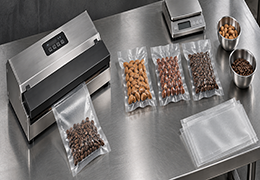
External vacuum sealers are used to package certain foods in compatible bags. Before purchasing a professional machine, it is important to understand how external air extraction works, how these machines differ from chamber vacuum sealers and their limitations when handling liquids or particularly moist products.
How does an external vacuum sealer work?
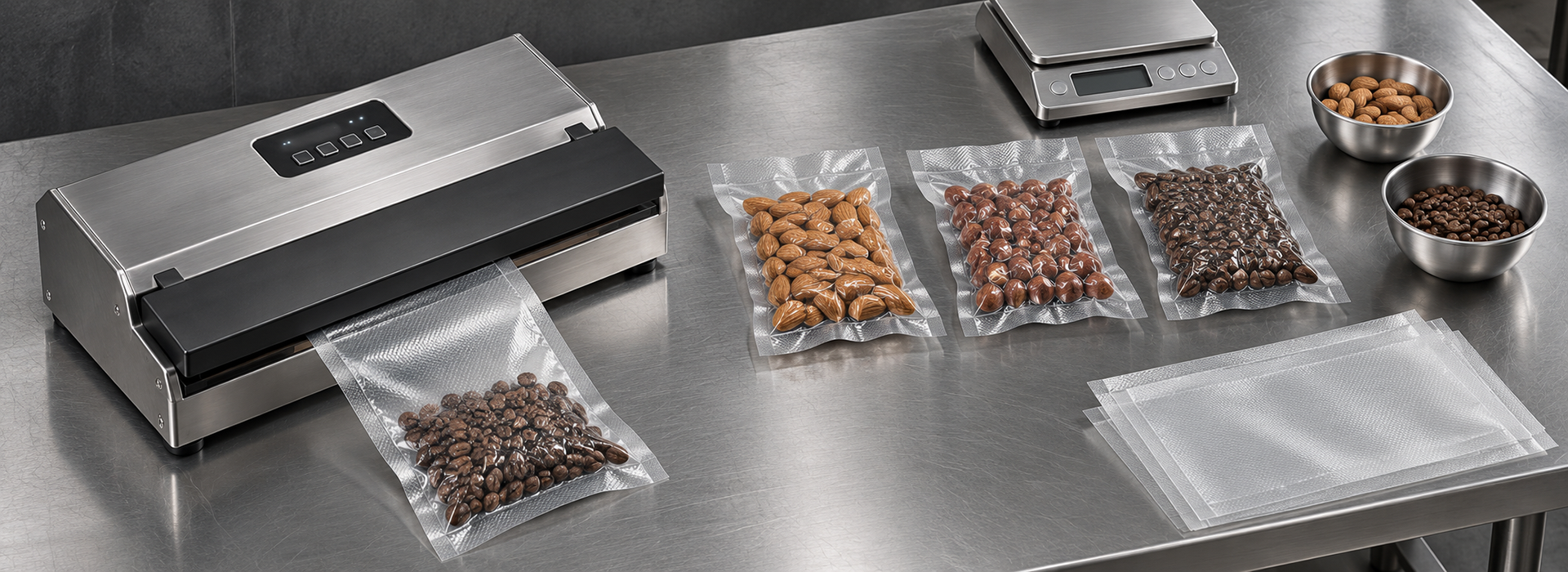
The machine removes air through the open end of a bag and then creates a heat seal.
This operating principle differs from chamber vacuum sealers, where the vacuum process takes place inside an enclosed chamber.
Many external suction models require embossed vacuum bags with a textured surface that allows air to travel toward the extraction system.
Material compatibility must always be checked against the manufacturer's instructions.
Which foods can be vacuum sealed?
The most straightforward applications generally involve relatively dry, solid products.
The pressure created during air extraction can deform particularly delicate foods.
It is therefore important to consider product consistency and any adjustment options provided by the machine.
Not all vacuum sealers offer the same functions.
External vacuum sealing and liquids
Conventional external vacuum sealers may have difficulty handling liquids and very moist preparations.
During extraction, liquid can reach the sealing area or suction system.
For sauces, soups and similar products, machine suitability must be explicitly verified.
In certain applications, a chamber vacuum sealer may be more appropriate.
Sealing bar and bag dimensions
Sealing bar width is one of the main dimensional limitations of a vacuum sealer.
Compatible bags must be selected and operating instructions followed.
The sealing area should be kept clean to support effective closure.
Vacuum packaging does not replace refrigeration
Vacuum packaging does not sterilize food.
Some microorganisms can grow in environments with little oxygen.
Food storage must therefore follow suitable time and temperature controls established through appropriate food safety procedures.
It is incorrect to assume that every vacuum-packed food automatically has a longer safe shelf life.
How to choose a professional vacuum sealer
Before purchasing, consider:
-
Types of food to be packaged.
-
Compatibility with vacuum bags.
-
Sealing bar width.
-
Frequency of use.
-
Available adjustment functions.
-
Cleaning and maintenance requirements.
A properly selected machine must be compatible with the products being handled and the expected intensity of use.
SEO TAGS
external vacuum sealer, commercial external vacuum sealer, professional vacuum packaging machine, embossed vacuum bags, vacuum sealing bar, food vacuum packaging, commercial kitchen equipment