Commercial Glasswashers: How to Choose the Right Model for Bars and Restaurants
A commercial glasswasher is an essential piece of equipment for bars, cafés, pubs, restaurants and other beverage-serving businesses. Choosing the most suitable model depends on workload, glassware dimensions, water characteristics and operational requirements. Evaluating these factors carefully helps organize the washing process and maintain consistent results over time.
How does a commercial glasswasher work?
A professional glasswasher is designed to wash glassware through cycles involving water, detergent and rinsing, according to the machine's specifications.
Compared with domestic dishwashers, commercial models are generally designed to handle frequent washing cycles and specific foodservice requirements.
Operation depends on the machine configuration and may include different wash programs, dosing systems and temperature-control devices.
Cycle duration is not the only parameter used to evaluate glasswasher performance.
Basket capacity, water characteristics and correct glassware loading also affect the final result.
What is the difference between a glasswasher and a commercial dishwasher?
Glasswashers and commercial dishwashers belong to the same equipment category, but they may be designed for different applications.
A glasswasher is generally used to wash glasses, cups and other items compatible with the machine.
Commercial dishwashers may be intended for plates, tableware and utensils, depending on the model.
Differences may include:
-
Washing chamber dimensions.
-
Usable loading height.
-
Basket dimensions.
-
Available programs.
-
Washing and rinsing systems.
-
Operating capacity.
Before purchasing, operators should verify which items can be washed and any limitations specified by the manufacturer.
Glasswashers with 35, 40 or 50 cm baskets: which should you choose?
Basket dimensions are among the main selection criteria.
Common professional configurations include 35 × 35 cm, 40 × 40 cm and 50 × 50 cm baskets.
Glasswashers with 35 × 35 cm baskets
These may be suitable for compact workstations and businesses with limited washing requirements, provided the capacity and usable height are compatible with the glassware.
Glasswashers with 40 × 40 cm baskets
These provide a larger loading area and may be appropriate for bars and cafés with regular glass and cup washing requirements.
Glasswashers with 50 × 50 cm baskets
These are available in professional configurations designed for different operational needs. The larger basket may accommodate greater loads, depending on the type of items.
Basket dimensions should not be confused with usable washing height.
For tall glasses, stemware and other special items, both measurements must be checked.
Usable washing height: why does it matter?
A common mistake is selecting a glasswasher based only on its external dimensions or basket size.
Internal usable height determines which items can be correctly placed inside the machine.
A café mainly using espresso cups and short glasses may have different requirements from a wine bar using large stemmed glasses.
Glassware compatibility with mechanical washing must also be verified.
Not all delicate glasses are suitable for every washing cycle.
Glasswashers with water softeners: when are they necessary?
Water hardness can significantly affect washing results.
Water containing high concentrations of calcium and magnesium salts can contribute to mineral deposits on surfaces and machine components.
These deposits may cause visible marks and scale buildup.
Under certain conditions, a water-softening system may be appropriate.
Some glasswashers have integrated water softeners, while other configurations require external systems, depending on the model.
Water treatment requirements should be assessed according to local water hardness and the manufacturer's instructions.
Detergent and rinse-aid dosing systems
Dosing systems help manage the chemicals used during washing.
Detergent is intended to remove dirt, while rinse aid is used during the rinsing stage according to the machine's system.
Some models may feature integrated dispensers, while others require different devices or configurations.
Incorrect dosing can compromise washing results.
Compatible products should be used in accordance with the instructions provided by both the machine and chemical manufacturers.
Water consumption and cycle duration
Water consumption is an important factor when selecting a commercial glasswasher.
Declared consumption may vary according to the model, program and operating conditions.
Cycle duration may also differ.
A shorter cycle does not automatically guarantee higher productivity.
Actual capacity should be assessed by considering basket loading and unloading times, as well as the number of glasses washed.
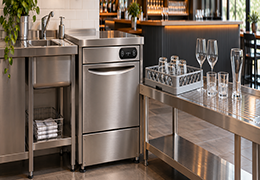
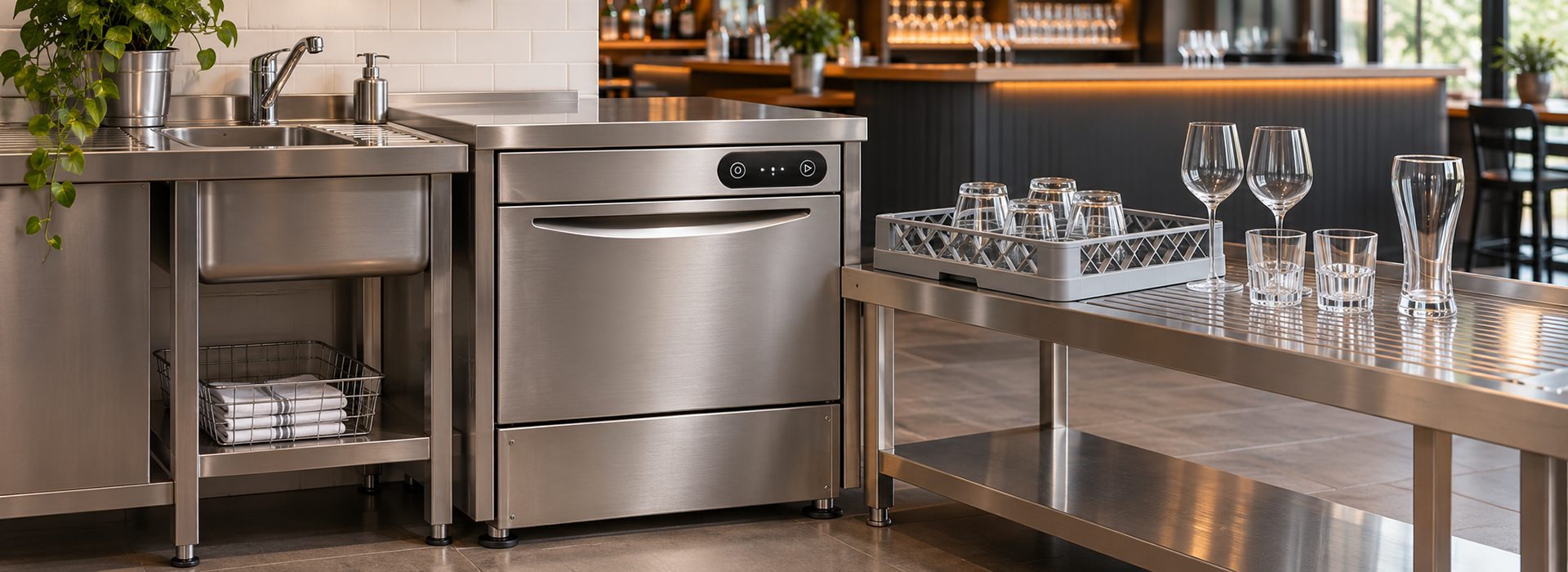
How to organize the bar washing area
Glasswasher positioning should support the movement of used glassware during service.
Separate areas should be provided for dirty and clean glasses, avoiding unnecessary interference.
The machine must also remain accessible for cleaning and maintenance.
Before installation, verify:
-
External machine dimensions.
-
Required electrical supply.
-
Water connection.
-
Drainage system.
-
Water pressure and characteristics, according to specifications.
-
Space required to open the door.
-
Maintenance and cleaning access.
Commercial glasswasher maintenance and cleaning
Proper maintenance helps preserve machine performance.
All operations should follow the manufacturer's instructions.
In general, filters and accessible components intended for routine cleaning should be checked regularly.
The possible presence of residues and mineral deposits should also be monitored.
Maintenance procedures vary according to the machine configuration.
How to choose the most suitable commercial glasswasher
Selection should begin with the actual needs of the business.
A small café with limited glassware volume may have different requirements from a pub or a venue with intensive evening service.
Loading capacity, glass dimensions, frequency of use and water characteristics should be considered together.
Available space and installation conditions also influence the decision.
A correctly sized glasswasher helps organize service and reduces the risk of washing operations becoming a bottleneck during busy periods.
Conclusion
A commercial glasswasher should be selected by evaluating the entire washing process rather than focusing only on price or cycle duration.
Basket dimensions, usable height, dosing systems, water treatment and operating capacity are essential considerations.
Proper selection and regular maintenance contribute to organized service and consistently clean glassware.
SEO TAGS
commercial glasswasher, professional glasswasher, bar glasswasher, restaurant glasswasher, 35x35 glasswasher, 40x40 glasswasher, 50x50 glasswasher, glasswasher with water softener, glasswasher detergent dispenser, commercial glasswashing equipment, bar washing equipment